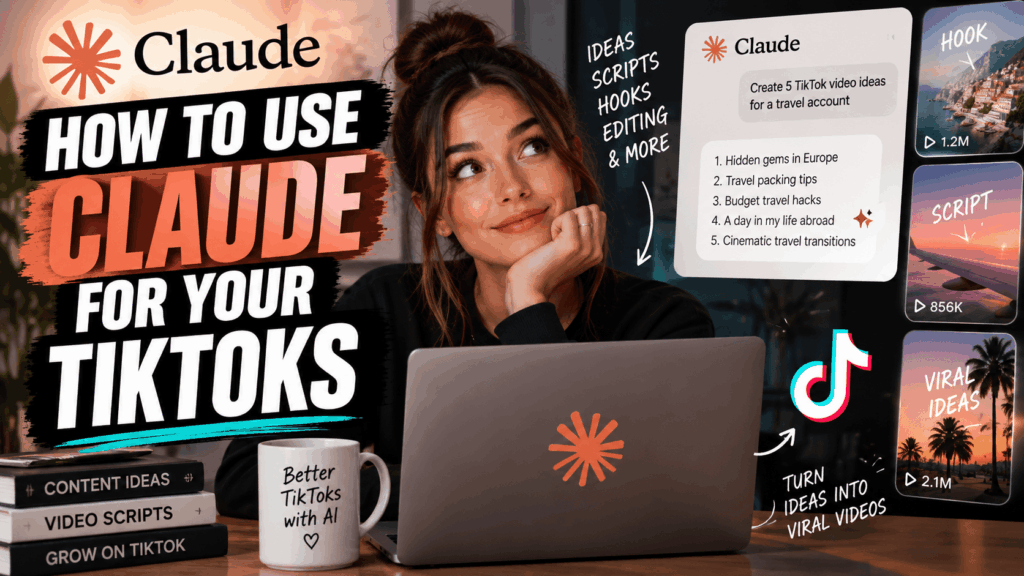
Claude is good at the part of TikTok that actually decides whether a video works, and bad at the thing almost everyone asks it for first. Ask it for ten viral hooks and you get ten pieces of furniture. Give it your own transcripts and your own numbers, and it turns into the most useful writing tool on the desk.
Two disclosures before anything else. We sell TikTok views, likes and followers, so weigh the distribution advice accordingly. And we built our own free AI script generator, which does one narrow slice of what follows. Neither changes the argument, but you should know both while reading it.
The prompt everyone starts with
It is some version of “give me 10 viral TikTok hooks about skincare”. The output is fluent, confident and useless, and it is worth being precise about why.
The model has no idea what your audience already knows, which of your videos landed, or what the other forty accounts in your niche said this week. So it writes the average of everything it has seen. The average hook on a platform where the average video fails is exactly the thing you cannot use.
You also get a specific texture. “Stop scrolling.” “Here’s the truth nobody tells you.” “You’ve been doing it wrong your whole life.” Those are not hooks, they are hook-shaped objects, and viewers have been trained to scroll past them precisely because generated content overuses them.
The fix is not a cleverer prompt. It is giving the model something only you have.
What it is genuinely good at
Every one of these works because you supply the raw material and Claude does the processing.
- Finding the hook already inside your script. Paste a rough script and ask which sentence is the strongest opening and why. Usually it is buried at position four, because you wrote your way into the point. This is the single highest-value use of the tool, and what makes an opener strong is set out in TikTok hooks.
- Reading your own analytics. Export your data and upload the file. Ask what the videos above your median retention have in common. You are asking it to find a pattern across thirty rows, which is a task it is reliably good at and you are reliably bad at.
- Cutting a long thing into short things. A podcast transcript, a blog post, a customer email thread. Ask for the eight moments that stand alone without setup. Repurposing is pattern-matching over text, which is the job.
- Arguing with your angle. Ask it to make the strongest case that your video idea is boring. Then ask what it would need to be interesting. Adversarial prompts get far more out of it than requests for approval.
- The unglamorous text. Captions, on-screen text that does not repeat the voiceover, keyword-aware descriptions for TikTok SEO, replies to a hundred comments. Tedious, necessary, and genuinely faster.
- Naming what went wrong. Paste a script that underperformed and the retention shape. Ask where attention most likely broke. It will not know for certain, and it will still be a better second opinion than staring at it again yourself.
The workflow that changes the output
The difference between useless and useful output is almost entirely what you put in front of it.
- Feed it your five best videos, as transcripts. Not descriptions of them. The actual words. Then ask what they have in common that your five worst do not. Now every later request has a reference point.
- Make it ask you questions first. “Before writing anything, ask me five questions about this video.” The answers are the specifics that make a script yours, and you will not think to volunteer them.
- Write the hook and the payoff yourself, and let it fill the middle. The two ends are where your judgement lives. The connective tissue is where a model saves you twenty minutes.
- Ask for one thing, not ten. Ten options invites skimming and picking the least bad. One option, then “make it more specific”, then “now cut it by a third”, gets you somewhere better in the same time.
- Give it the constraint that actually binds. Twenty-two seconds. Spoken aloud. No sentence longer than nine words. Constraints do more for the output than adjectives like “engaging” ever will.
- Keep the voice somewhere it persists. On a paid plan, a Project holds your transcripts and voice notes so you stop re-pasting them. On the free plan, memory across conversations covers some of this. Either way, set it up once rather than re-explaining yourself weekly.
Making it stop sounding like a robot
Generated text has tells, and on TikTok the tells cost you the first two seconds.
The pattern to watch for is the tricolon, the rule-of-three list that sounds like rhythm and carries no information. “It’s fast, it’s simple, and it’s completely free.” Ask it to cut every three-part list and the prose immediately sounds more like a person.
The second tell is throat-clearing. Generated scripts open by announcing what they are about to say. A human opens mid-thought. “Before you buy that serum, look at the third ingredient” beats “Today I’m going to be talking about how to choose a serum” every time, and the second one is what you will be handed by default.
The fix that works better than any instruction: give it three of your own scripts and tell it to match the rhythm, not the topic. Style transfer from real examples beats a hundred words of description about your brand voice.
Free or paid, for this specific job
The honest answer is that the free tier does most of what a creator needs, and the paid one changes your habits rather than your output.
Free covers chat on web, desktop and mobile, web search, file uploads and memory across conversations. That is enough to run everything above, one conversation at a time.
The paid plans add Projects, which is the feature that matters here, because a Project is where your transcripts and your voice sit permanently. They also add higher usage limits, which is what you actually hit if you script daily. Current plans and prices are on Anthropic’s pricing page, and they move, so check there rather than trusting a number in a blog post.
Our advice is to run the free tier for two weeks first. If you stop because you ran out of usage rather than out of ideas, that is your answer.
What it does not know
Three limits, and the first one catches everybody.
It does not know what is trending right now. A model is trained up to a cutoff date, so its sense of current sounds are stale by definition. It can search the web when asked, which helps for facts and not much for sounds, because the trend you want is visible in your own For You feed and nowhere else. Take trends from the app. Take structure from the model.
It cannot watch your video. Everything it tells you about pacing is inferred from your description of the pacing. If you say the first three seconds are slow, it will agree with you, because you told it so. That is a mirror, not a second opinion, and it is worth noticing which one you are getting.
And it will state things confidently that are wrong. In a niche where a claim can be checked, check it. That matters most in finance, health and legal content, where a fluent wrong sentence in your script is your problem once you have said it on camera.
Do you have to label it?
This is the question we get most, and the answer is more reassuring than people expect.
TikTok’s disclosure rule is about synthetic media, not about AI assistance. The policy as published in September 2023 requires labelling content that contains realistic images, audio or video generated by AI. A script you wrote with help and then performed yourself on camera is not synthetic media. Your face is your face and your voice is your voice.
The line lands in a sensible place. Write with Claude and film yourself, and there is nothing to disclose. Generate a realistic presenter, a cloned voice or a photoreal scene, and the label applies. That is the same boundary we set out in using Higgsfield for your TikToks, where the output actually is synthetic and the rules bite.
Be aware that detection does not depend on your honesty either way. TikTok reads C2PA Content Credentials on upload, and since November 2025 adds an invisible watermark on top. That machinery is aimed at generated pixels and audio. Text you wrote with an assistant carries none of it.
The rule that still applies
Monetisation is where AI assistance can genuinely cost you, and it is not about the label.
The Creator Rewards Program turns on originality. TikTok’s eligibility criteria exclude content copied from others or made with minimal original input, along with a low-quality bucket covering things like slideshow videos and meaningless reactions.
A script you developed with Claude, then performed, edited and posted, is original work by any reading. You made every decision that matters. Text-to-speech read over stock footage from a prompt you did not customise is the version that sits close to the line, and it is close to the line whether or not a model was involved.
The distinction is what you added, not what tool was open while you added it.
Where we stand
We sell TikTok views and the rest, so read this paragraph most sceptically.
Writing is the highest-leverage thing you can improve, and it is the cheapest. A better hook costs nothing and changes the retention curve from the first second. Nothing we sell does that, and neither does better footage. We said the same thing at the end of the Higgsfield piece and it is worth repeating, because it is the one claim on this site that nobody has a product to sell against.
What Claude will not do is make you post. Volume and rhythm beat polish over any period longer than a week, which we cover in how often to post on TikTok. If better scripts drop you from five posts a week to two, the tool has cost you more than it gave, and that failure mode is common enough to plan against.
And it cannot tell you whether your account is in a state where any of this helps. Our free Health Scan reads a public profile and will tell you not to bother, when that is the honest answer. We set out the wider caution in the risks of fake engagement.
Frequently asked questions
Do I need to label a TikTok if Claude wrote the script?
No. TikTok’s rule covers realistic AI-generated images, audio and video. A script is text, and once you perform it on camera the video is a recording of you. Nothing about writing assistance triggers the AIGC label.
Can Claude tell me what is trending on TikTok?
Not reliably, and this is the wrong job for it. Training data has a cutoff, so its sense of current sounds and formats lags. Get trends from your own For You feed, then use Claude for the structure and the words.
Is the free plan enough for making TikToks?
For most creators, yes. Free includes chat across web, desktop and mobile, web search, file uploads and memory across conversations, which covers the whole workflow above. Paid adds Projects and higher usage limits, and usage is what you run out of first if you script daily.
Why do the hooks it writes sound generic?
Because you asked for hooks without giving it anything specific to work from, so it returned the average of its training data. Paste your actual script or transcript and ask which line is the strongest opener instead. The output changes completely.
Can I monetise videos scripted with AI?
Yes, if the video clears the originality bar that applies to everything else. Writing with assistance and then filming, editing and posting it yourself is original work. Prompt in, text-to-speech out, over stock footage is the version that gets flagged.
Will it copy someone else’s script if I paste one in?
It will imitate whatever you give it, which is exactly why you should paste your own work rather than a competitor’s. Use rivals for what topic is working, and your own back catalogue for how it should sound.
Claude or ChatGPT for this?
Honestly, the workflow matters more than the brand. Everything above works on any capable assistant. We wrote this one about Claude because it is what we use for long text, and we would rather say that than pretend we ran a controlled test we did not run.
The short version
Asking for ten viral hooks gets you the average of the internet, which on a platform where the average video fails is the one thing you cannot use.
Give it your material instead. Your transcripts, your analytics export, your five best and five worst videos. It is good at finding patterns in text you supply and poor at inventing specifics you did not.
Write the hook and the payoff yourself, let it fill the middle, and cut every three-part list it hands you. Style transfer from your own scripts beats any description of your brand voice.
No label is needed. TikTok’s disclosure rule covers synthetic images, audio and video, not scripts you perform yourself. The originality bar for monetisation still applies, and a video you wrote, filmed and edited clears it.
It will not tell you what is trending, it cannot watch your video, and it will be confidently wrong in niches where that costs you. Everything else is the best use of twenty minutes in your week.