When this guide first went up in 2022, TikTok search was a curiosity. It is not any more. A large share of younger users now open TikTok to look something up the way they would open Google, and the New York Times was writing about that shift before most creators had noticed it. Google now surfaces TikTok results directly too, which means a video can be found by people who never opened the app.
That changes what a video is worth. A video that only rides the For You feed has a lifespan of a few days. A video that answers a question people search for keeps being found months later. This guide covers how to make yours the second kind.
If you are here because the follower count is the actual goal, search is one route into it. Our guide on how to get more TikTok followers covers the rest of the picture.
Why TikTok search is worth optimising for
Two reasons, and the second matters more than the first.
Search traffic does not decay. The For You feed decides in a few hours whether your video travels, and then moves on. Search keeps returning the same video to the same question for as long as it is the best answer. One video that ranks for a question people ask every week is worth more than three that spiked and died.
Search traffic converts better. Someone who typed a question and found you had intent. Someone who was served you between two other videos did not. That difference shows up in follows, not just views: people who searched are far likelier to look at your profile afterwards.
1. Search your niche before you script
Say you make beauty content and your recent videos have gone nowhere. Open the TikTok search bar and type your broad topic. What TikTok suggests underneath is not decoration, it is a list of what people are actually typing.
For “beauty trends” the suggestions have historically included phrases like:
- Popular beauty products
- Trending beauty filters
- Beauty trends men hate
- Trending beauty supplies
Two uses for that list. The obvious one is content ideas. The more valuable one is language: those exact phrases are what you should be saying out loud and putting on screen, because that is what the system is matching against.

One caveat on an old trick. Creators used to write keywords on screen and drag them out of frame so viewers could not see them. Do not build a strategy on that. Put the phrase somewhere it genuinely belongs: spoken in the first line, written in the caption, or on screen where it actually helps the viewer. Hidden text is fragile and it makes the video worse for the person watching it.
2. Use the name field, not just the username
Your display name is searchable. Your username is the handle people type to find you; the name field is the line underneath, and most creators leave it as a duplicate of the handle or a string of emoji.
That field is roughly thirty characters of prime search real estate. If your niche is real estate in Los Angeles, “LA Real Estate Tips” in the name field will surface you for searches your handle never would. It also tells anyone who lands on your profile what the account is for, without them having to scroll your grid and work it out.
There is a second effect people miss: the name shows on every comment you leave. Comment usefully on larger accounts in your niche and that line is doing quiet work in front of exactly the audience you want.
3. Say the question out loud, and write it down
TikTok reads more of your video than the caption. Spoken words are transcribed, and on-screen text is read. A video where you say “here is how to fix it” over text that says nothing specific is throwing away both channels.
The pattern that works for search is simple and slightly unnatural at first: state the question in the first two seconds, in the words someone would actually search. Not “this changed everything for me” but “why does my watch time drop after five seconds”. Put the same phrase on screen. Put it in the caption too. Three surfaces, one phrase, no keyword stuffing required.
4. Length is a tool, not a target
This is the section that has aged most since 2022. Back then the advice was flipping from “keep it under fifteen seconds” to “longer is better”, and plenty of people took that as a rule. It is not one.
What TikTok is measuring is whether people stay, not how long the video is. Your analytics show a retention graph for each video, and that graph is the honest feedback. A ninety second video that most people finish beats a ninety second video that loses everyone at twenty, and both are decided by the same thing: whether the video earned the length it asked for.
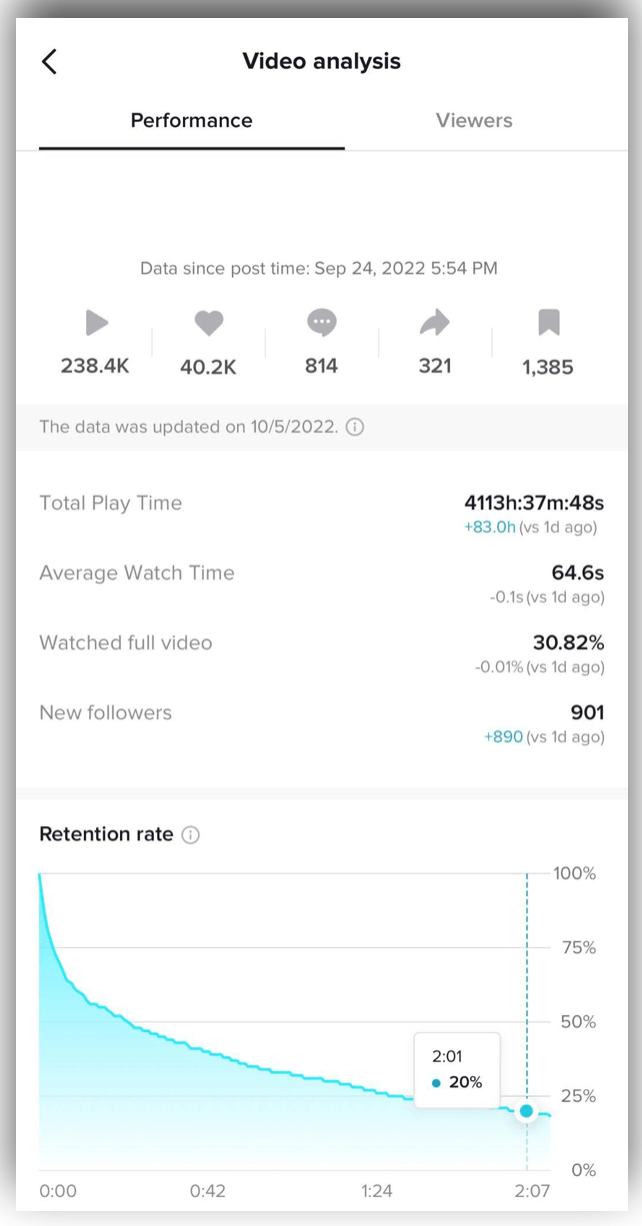
Search rewards length more than the For You feed does, because a searcher arrived wanting an answer and will sit through a real one. So if a question genuinely needs ninety seconds, take them. If it needs twelve, take twelve. The mistake is padding a twelve second answer to ninety because someone said long-form is favoured.
5. Give the algorithm a consistent subject
TikTok builds a model of what your account is about and who it suits, and search leans on that model. An account that posts about one thing gets surfaced confidently for that thing. An account that posts about four things gets surfaced tentatively for all of them.
This does not mean never varying. It means the through-line should be obvious to a stranger reading three of your videos. If it is not obvious to them, it is not obvious to the ranking system either.
Common mistakes
- Keyword stuffing the caption. A caption listing fifteen phrases reads as spam to humans and adds nothing for search. One clear phrase beats fifteen.
- Hashtags in place of language. Hashtags still help categorise, but they are not how search matches a query to a video. What you say and what you write on screen matter more.
- Optimising a video nobody finishes. Search ranking still depends on engagement. A well-optimised video that loses viewers at three seconds will not rank for anything.
- Changing your handle to chase keywords. Use the name field for that. Changing the handle breaks every existing link and mention pointing at you.
Frequently asked questions
Does TikTok SEO actually affect how many views I get?
It affects where views come from and how long they keep arriving. Search will rarely give you a spike the way the For You feed can, but it keeps delivering long after a spike would have finished.
Should I put keywords in the caption or on screen?
Both, plus say it out loud. Spoken audio is transcribed and on-screen text is read, so a phrase that appears in all three places is unambiguous. Once each is enough.
How long should my videos be for search?
As long as the answer needs and no longer. Searchers tolerate more length than scrollers because they came for an answer, but retention is still what decides ranking.
Do hashtags still matter?
They help categorise a video, but they are not the main way search matches a query. Spend the effort on the first two seconds and on saying the actual phrase instead.
The short version
Find the phrases people type by reading TikTok’s own search suggestions. Say one of them out loud in the first two seconds, write it on screen, and put it in the caption. Use the name field to state what your account is about. Let the retention graph, not a rule about length, tell you how long a video should be. Search traffic is slower to arrive than a For You spike and it does not stop, which over a few months is the better trade.