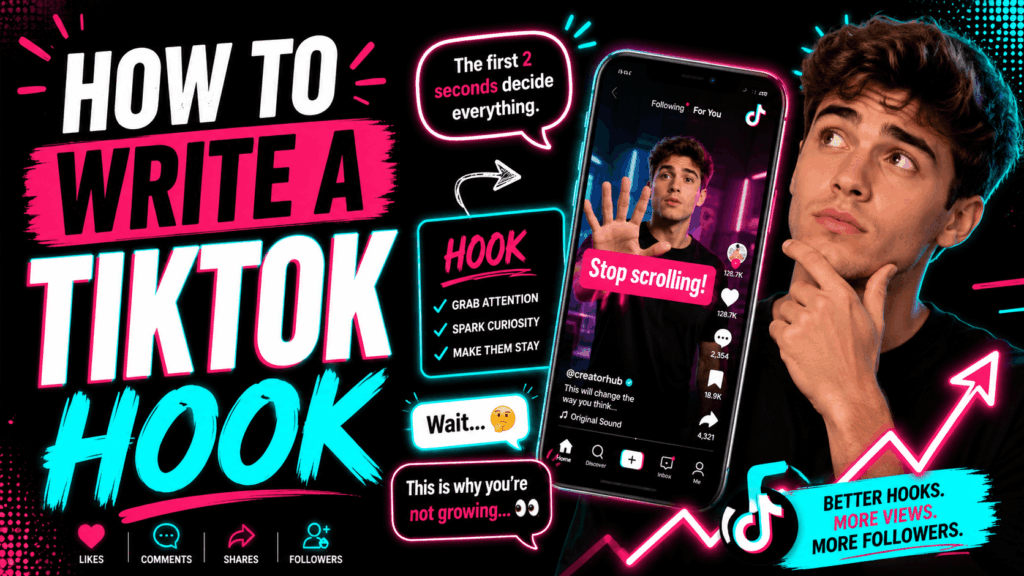
Every piece of TikTok advice starts in the same place: the first few seconds decide everything. It is repeated so often that it has stopped meaning anything. Almost nobody follows it with the part that would actually help, which is what a good opening is made of and why a bad one loses people who were, a moment earlier, willing to watch.
A hook is not the first sentence of your script. It is the reason the second second happens. That distinction sounds like word games until you look at what it changes in practice, which is nearly everything about how a video gets written.
What the opening actually decides
TikTok’s own explanation of the For You feed is unusually direct about this. In how it recommends videos, the company says watch signals are weighted heavily, and that finishing a longer video is treated as a strong indicator of interest. In the same document it says something people quote less often: follower count is not a direct factor, and neither is whether your past videos did well.
Read those two together and the mechanism falls out. Every video is shown to a small group first. What that group does, above all whether they stay, decides whether it gets shown to a larger one. Your account history does not carry a weak video, and it does not hold back a strong one. The opening is where most of the staying or leaving happens, so the opening is where the distribution is won or lost.
That is the whole reason hooks matter. Not because attention spans have collapsed, which is a claim worth looking at directly, because it is the justification most hook advice is built on and it is false.
The eight seconds thing is not real
You have seen the statistic. Humans have an eight-second attention span, shorter than a goldfish. It appears in social media decks, agency pitches and a large share of the advice written about short-form video.
It has no source. The BBC traced it in 2017 in Busting the attention span myth. The number came from a 2015 Microsoft Canada marketing report, which cited a site called Statistic Brain, which could not produce the research behind it. The goldfish half is no better: goldfish are used in memory experiments precisely because they remember things for far longer than nine seconds.
There is real research on the same territory, and it says something different. Gloria Mark at UC Irvine has measured how long people stay on a single screen before switching for two decades. In 2004 it averaged about two and a half minutes. By 2012 it was 75 seconds. In recent years it has been around 47 seconds, and other researchers have replicated the finding at 44 and 50.
Forty-seven seconds is not eight. It is also not a limit on how long anyone can concentrate. It is how quickly people switch when switching is free, which is the actual condition of a TikTok feed. Nobody is incapable of watching your video. They are one thumb movement away from a different one, and that is a different problem with a different solution.
The solution is not to compress everything into two seconds. It is to make the next moment feel necessary.
A hook is a gap, not a sentence
The most useful way to think about an opening is that it has to open something. A question the viewer now wants answered. A claim they want to check. A situation whose ending is not yet visible. Once that gap exists, staying is the path of least resistance and leaving costs something.
Most weak hooks fail because they close the gap instead of opening it. “Here are three tips for growing on TikTok” is a complete statement. Nothing is missing. The viewer already knows the shape of the next thirty seconds and can decide, correctly, that they do not need it.
Compare it with a version that leaves something open. “Two of these three tips are the ones nobody tells you, and the third one is wrong.” Same video, same content. One of them has an unresolved thing in it.
That is the test, and it is stricter than it sounds. After your first line, is there something the viewer does not yet have? If not, you do not have a hook. You have an introduction, and introductions are the single most common reason a video never leaves its first audience.
The openings that are dead before they start
Some of them are so common they read as neutral, which is worse than reading as bad. A neutral opening still costs you the same two seconds.
- Greetings. “Hey guys”, “welcome back”, “what’s up everyone”. These are broadcast conventions from a medium where the audience had already chosen to be there. On a feed, nobody chose.
- Announcing the video. “In this video I’m going to show you”. You are describing the thing instead of doing it. Start with the thing.
- Asking for the follow first. It costs retention at the exact moment retention is most expensive, and it asks for a commitment from someone who has not yet been given a reason. Any ask belongs at the end.
- “Stop scrolling.” It is an instruction with no argument attached. It also flags itself as marketing in three syllables.
- Slow visual openings. A logo, a title card, three seconds of establishing shot. The clock is running on all of it.
None of these are unforgivable. They are just spending the most valuable seconds you have on nothing.
Write the muted version too
A large share of first views happen with the sound off, and most scripts are written as though that never happens. The voiceover carries the idea, captions are generated from the voiceover afterwards, and the result is a video that says nothing at all to someone scrolling in silence.
On-screen text is not a transcript. It is a parallel track with its own job: fewer words than the audio, carrying the idea on its own, timed to change when the shot changes. TikTok’s own advertising research points the same way. Its creative best practices report that 90% of ad recall is captured in the first six seconds, and that creative which gets people reading increases view time.
The practical version of this is simple. Write your hook, then cover the audio and read only what is on screen. If the gap you opened is still open, it works muted. If it is not, half your first audience is getting nothing.
Specific beats clever
The most common weakness in an opening is not that it is boring. It is that it is vague. “Great results”, “a lot of people”, “this changed everything”. These are the phrases that appear when the writer does not have the detail, and they read as noise because that is what they are.
A number, a timeframe or a name does more work in four words than a paragraph of enthusiasm. “Three clients in eleven days” is not a better sentence than “amazing results” because it is more exciting. It is better because it is checkable, and checkable claims are the ones people stay for.
This is also the part no tool can do for you. A generator does not know your numbers and should never invent them. What it can reasonably do is leave you a blank where a real detail belongs.
Where the tool fits
Writing openings is a volume problem more than a talent problem. The good one is usually the eighth, and most people stop at the second because writing eight versions of the same two seconds is genuinely tedious.
That is what our free AI TikTok Script Generator is built to shorten. You set a brief, choose what the video is for, and it gives you ideas, then a set of hooks to choose between, then a shot-by-shot script built on the hook you picked. The goal you choose changes the structure rather than just the wording, which is the part most tools get wrong: a video written to be saved states its outcome up front, and a video written to be shared withholds it. Both are correct, and they are not the same script.
It runs on a free account with ten full scripts a month and no card, and it is deliberately built not to invent facts on your behalf. Where a claim needs your numbers, it leaves a bracket for you to fill.
Treat the output as a draft to argue with. The scripts that do best are almost always the ones a creator has changed a line of, because they know something the tool does not.
Test the hook against your own numbers
Everything above is a general rule, and general rules are worth exactly as much as your own retention data says they are.
Creator and business accounts get per-video analytics that include average watch time and how many people watched the full video. Those two numbers, read across ten videos rather than one, tell you more about your openings than any advice does. A video with a strong hook and a weak middle looks different from one that loses people immediately, and the fix is different too.
If you are not sure whether the account itself is underperforming or just behaving normally, our TikTok Health Scan reads your public numbers from a username and tells you which of the two you are looking at. For the wider mechanism, how to get more views on TikTok covers how distribution works past the opening, and engagement rate covers how to read your own figures without panicking at them. If you are still adjusting your schedule instead of your first two seconds, best time to post explains why that is the smaller lever.
Where we stand
We sell TikTok views and likes, so weigh this the way you would weigh anything from a seller. Nothing we sell fixes a hook. Bought numbers do not create watch time, and watch time is the entire subject of this article. A video that loses people in the first two seconds loses them at any view count.
What bought engagement does is cosmetic, and the cosmetic effect only matters in the first day or so while a video is still being shown to new people. If you want to see what that looks like before paying for it, 100 free TikTok views takes about twenty minutes, needs no password and lets you pick the video. If it turns out worth doing at scale, buying views is the paid version and likes work on the same narrow logic.
Neither is a substitute for the two seconds at the front, and anyone telling you otherwise is selling harder than we are.
Frequently asked questions
How long should a TikTok hook be?
Short enough that the gap is open before the viewer has decided anything, which in practice is one line. The useful measure is not seconds but structure: has something been left unresolved by the end of your first sentence. A two second hook that closes its own loop is worse than a three second one that does not.
Do I really only have three seconds?
The specific numbers you see quoted are mostly invented, including the eight-second attention span, which the BBC traced to a marketing report with no research behind it. What is true is that leaving costs nothing on a feed, so every second has to justify the next one. That is a stricter standard than a countdown, not a looser one.
What makes a hook work?
It opens something the viewer wants closed: a question, a claim they want to check, or a situation whose ending is not yet visible. Specificity does most of the rest. A number or a timeframe in the opening line outperforms enthusiasm, because it is checkable.
Should the hook be spoken or on screen?
Both, and not identically. A lot of first views are muted, so on-screen text has to carry the idea on its own rather than repeating the audio word for word. Write the hook, then read only the on-screen text and check the gap is still there.
Can a good hook save a weak video?
It can get the video watched, which is not the same thing. If the middle does not pay off what the opening promised, people leave at the first transition and the video stalls anyway. A hook buys attention. It does not create anything to spend it on.
Is it worth using an AI tool to write hooks?
For volume, yes. Ten hooks written quickly and judged against each other beats one hook written carefully, because you cannot tell which opening works by looking at it alone. Use the output as raw material rather than a finished script, and never let a tool invent a statistic or a result on your behalf.
Do hashtags or posting time matter more than the hook?
No, and it is not close. Both change who sees the first test. The hook changes what that audience does, and what they do is the thing the recommendation system is actually reading.
The short version
TikTok shows every video to a small audience first and decides everything from what that audience does, with follower count and past performance explicitly not direct factors. The opening is where most people stay or leave, which is why it carries the distribution.
The eight-second attention span behind most hook advice does not exist. The real number is about 47 seconds on any screen before switching, and it describes how cheap switching has become rather than a limit on anyone’s concentration. The response is not compression. It is making the next moment necessary.
Open a gap instead of closing one. Cut the greeting, the announcement and the early follow request. Write the muted version as its own track. Choose the specific detail over the enthusiastic one. Then write eight versions and keep the one your retention curve likes, because that is the only opinion in this article with your own audience behind it.