To launch a SaaS on social media, first build a small audience on one or two platforms for six to eight weeks. Then launch with a short video that shows your product doing one thing others cannot, on a day your whole team can be online. Afterwards, list the product on directories such as Product Hunt, SaaSHub and Gappsy, so people keep finding it once your posts stop travelling. This guide covers each step. It includes two launch videos that went viral, what a study of 194 launch videos found, and how the three directories work.
We sell TikTok and Instagram followers, likes and views, so we spend our days on social media, but we do not run a SaaS directory. No company in this guide has reviewed it. Every number comes from the company’s own pages, its public statements or press coverage, and we checked them on 13 November 2026. View counts change daily, so we give them as they stood on that date.
What a social media launch is, and what it is not
A launch is a planned spike of attention. For a few days, more people than usual look at your product at the same time, and social media is how you create that spike. However, the spike itself is not the goal. The goal is signups that turn into active users, and active users who start paying.
The difference matters, because the two are easy to confuse. A launch video with a million views and 40 signups has failed. A post seen by 3,000 developers that brings 300 signups has worked. So decide before launch day which number you will judge it by. For most SaaS products, that is the number of activated accounts after 14 days.
Also, a launch is not a single post. It is a sequence: weeks of building an audience, one concentrated day, and months of follow-up. Most launches that fail do so quietly, and rarely because of the product. Instead, they fail because nobody was waiting for them.
Before launch day: build the audience first
Six to eight weeks is a realistic run-up. It gives you enough posts to find your voice, and enough followers to carry the first wave. Here is what to do in that time.
- Post from the founder’s own account. People follow people more readily than logos. A brand account can share the posts, but the founder’s voice is what carries them.
- Build in public. Share the problem you are solving, screenshots, small wins and honest numbers. One useful post every weekday beats a burst of ten in a single week.
- Start a waitlist with one field. Ask for an email address and nothing else. Then give people a reason to join, such as early access or a founding price.
- Write a launch list. Name 50 to 100 people who have promised to try the product on day one. Think of beta users, peers in your niche and people who often reply to your posts.
- Help in communities first. Answer questions on Reddit, in Slack groups and in Product Hunt’s own forums before you ask anyone for anything. Product Hunt’s launch guide gives the same advice.
- Prepare your assets. You need the launch video in two formats, five screenshots, a one-line tagline, a short founder story and answers to the ten questions you expect.
Choose platforms by where your buyers already are
You cannot launch everywhere at once, and you do not need to. Instead, pick the one or two places where your buyers already spend time, and do those properly. This table is a starting point.
| Platform | Best for | What works there |
|---|---|---|
| X | Developer tools, AI products, indie SaaS | A launch video of about a minute from the founder, with a thread of details below it |
| B2B tools for sales, HR, finance and operations | A founder post about the problem, with a native video or a document carousel | |
| TikTok | Consumer apps, prosumer apps and creator tools | Vertical clips of the product solving one real problem on screen, several times a week |
| Design, small business and lifestyle tools | The same vertical cuts as Reels, plus Stories on launch day | |
| YouTube | Anything that needs a proper demo | A walkthrough of two to five minutes, plus Shorts cut from it |
| Reddit and Hacker News | Technical and developer products | Plain text, an honest story and a reply to every comment |
If your buyers are consumers or creators, short video deserves most of your time. On the other hand, if they buy software for a company, start with LinkedIn and X. Either way, tell the same story everywhere. The cuts differ, but the promise should not.
Example 1: Lovable turns every update into a launch
Lovable, the Swedish AI app builder, launched publicly in November 2024. It said it passed $100 million in annual recurring revenue about eight months later. Then, in November 2025, it told TechCrunch it was nearing 8 million users. Plenty drove that growth, but its launches follow a pattern that is easy to copy.
Watch it once with the sound off, because that is how most people scroll. Within seconds you know what changed: several people building one app together. After that, the product does the talking. There is no long introduction, no stock footage and no feature list read aloud.
Three things are worth stealing.
- Every major update is a new launch. Lovable’s Product Hunt page lists launches in 2024, twice in 2025 and three times in 2026. Product Hunt allows this, and its guide even says to relaunch whenever you ship a major update.
- One idea per video. The 2.0 video sells one change, not twenty. As a result, it is easy to share and easy to remember.
- Short and finished. At 80 seconds, it is long enough to show the product working and short enough to watch twice.
Example 2: Manus made scarcity part of the launch
Manus, a general AI agent, launched on 6 March 2025 with a demo video and an invite-only preview. The company said more than 2 million people joined its waitlist within seven days. According to press reports, fewer than one in a hundred of them had received an invite code in that first week.
Manus opened to everyone in May 2025. In December, it said it had passed $100 million in annual recurring revenue eight months after launch. At the end of December, Meta announced it would acquire the company, which The Wall Street Journal reported at a value above $2 billion.
This video works differently from Lovable’s. It runs just over four minutes, and it shows the agent finishing whole tasks from start to end. That suited the product, because the claim was that the agent could do real work on its own. A 30-second clip could not have proved that.
Meanwhile, the invite system did the rest. Because few people could get in, those who did posted their results, and everyone else asked how to get a code. Scarcity only works when the product delivers, though. If the first users had been let down, the same posts would have spread their disappointment just as fast.
The classic: Dropbox’s demo video in 2008
Launching with a video is older than most of today’s platforms. In March 2008, Drew Houston posted a short demo video of Dropbox on Digg, a news site that was popular with tech readers. He filled it with in-jokes for that audience. According to Houston, the beta waiting list then grew from 5,000 to 75,000 people overnight.
The lesson still holds. The product was not finished, so the video showed exactly what it would do, in a way its audience recognised as made for them. Today, the equivalent is a launch video cut for one community, in that community’s own language.
What a study of 194 launch videos found
In 2026, Infinite published a study of 194 startup launch videos posted on X. It scored each video on about 20 traits and compared those with the views it got. The figures below are medians from its August 2026 update. They show correlations rather than guarantees, since account size and luck play a part too.
- The gap is enormous. The top 20 videos drew 82.6 million views between them. By contrast, the bottom 20 drew 323.
- Clarity is not the difference. Nearly nine in ten videos were clear. So clarity is the minimum, not the edge.
- The hook decides. Videos with a strong hook had a median of 32,119 views, while weak hooks had 196.
- Open on a face. Videos that opened on a person had a median of 976 views, against 164 for a text card.
- Be visibly different. Strongly differentiated videos had a median of 9,385 views. Videos that looked like everyone else’s had 146.
- Do not go too short. The median video ran 52 seconds. Clips under 15 seconds had a median of 75 views, whereas videos over 90 seconds had 4,396.
- Landscape won on X. Videos in 16:9 had a median of 1,198 views, against 107 for vertical 9:16. However, that is a finding about X, not about TikTok.
- Timing matters least. Tuesday posts did best and Sunday posts did worst, but the study calls timing the weakest lever.
How to make the launch video
You do not need a studio. You need a clear script, a screen recording and a phone. So use this six-part structure for a video of 45 to 90 seconds.
- Hook, 0 to 3 seconds. State the pain or show the surprising result. Start with your face or with the product in motion, not with a logo.
- Problem, 3 to 10 seconds. Show the old way and why it hurts, in one sentence.
- Demo, 10 to 45 seconds. Show the product solving that problem in real time, and cut out every loading screen.
- Difference, 45 to 60 seconds. Say the one thing it does that others do not. In the study, clearly different videos had a median 64 times higher than the rest.
- Proof, 60 to 75 seconds. Add a number, a quote from a beta user or a result.
- Call to action, the last 5 seconds. Tell people exactly what to do next: try it for free, join the waitlist or reply with a question.
Add burned-in captions, because many people watch without sound. Then export two versions: a landscape one for X, LinkedIn and YouTube, and a vertical one for TikTok, Reels and Shorts. If TikTok is part of your plan, our guide to TikTok hooks covers the first three seconds in more depth. Also, our article on how long a TikTok should be helps with the vertical cut.
Write the launch post
The video carries the launch, but the words around it decide whether people click. Keep the post short and specific. This template works on X and LinkedIn with small changes.
- The hook: the result in plain words. For example, “Turn a two-hour report into a two-minute one.”
- Who it is for: “For finance teams that still copy numbers between spreadsheets.”
- What is new: one sentence on how it works.
- The offer: a free plan, a trial or a founding price, and how long it lasts.
- The ask: “Try it, and tell me what is missing.”
Then add the video, and put the link where the platform shows it best. For example, many founders on X put it in the first reply under the post. Finally, pin the post to your profile for launch week.
Cut it for each platform
The same story needs a different cut on each platform. Here is how to adapt one video without making six.
- X: post the landscape version natively, with a first line that repeats the hook. Then put the details in a thread below it.
- LinkedIn: lead with the problem in plain words, then the video. Say who it is for, because LinkedIn readers decide quickly whether a post is about them.
- TikTok and Reels: post the vertical cut, then keep posting. One launch clip rarely carries a new account, so plan three to five clips in the first week, each showing a different use.
- YouTube: upload the full walkthrough and pin a comment with the link. After that, cut two or three Shorts from it.
- Reddit and Hacker News: skip the video. Instead, write a plain post that explains what you built, why, and what you want feedback on. Then answer every comment yourself.
On TikTok, the first hour after posting is when the app tests a video on a small audience. Our guide to a TikTok’s first hour explains what it measures, and how to give a launch clip a fair start.
Launch day, hour by hour
Pick a day your whole team can be online from morning to night. Product Hunt’s advice is the same: the best day is the one you are most prepared for. If you launch there too, every launch goes live at 12:01 a.m. Pacific Time. For most of the year, that is 9:01 in the morning in Central Europe.
- Morning: publish the launch post on your main platform. Next, email your waitlist with one link and one ask: try it and tell us what you think. Then message your launch list personally.
- The first two hours: reply to every comment, quickly and in full sentences. Early replies keep a post alive, and they show newcomers that a real person is there.
- Midday: post the version for your second platform. Also share early reactions as screenshots or quotes, with permission.
- Afternoon: fix the first bugs people report, then post that you fixed them. Few things build trust faster on launch day.
- Evening: thank everyone in a short post with your first numbers. Signups and feedback are more useful to share than views.
Do not ask anyone to upvote, like or share on command. On Product Hunt, that breaks the rules, and elsewhere it makes the launch look needy. Instead, ask for feedback and comments, which is also what Product Hunt recommends.
Social proof: show that real people use it
People trust what other people already use. That is why the first days after launch are the moment to collect proof, while reactions are fresh.
- Quotes from beta users. Ask each one for a single sentence about the result they got, and use their name and role if they agree.
- Screenshots of real messages. A kind reply on X or a happy email says more than any claim you write yourself. Always ask before you share one.
- Honest counts. “1,200 teams in week one” is proof. Even so, only share numbers you would be happy to defend.
- Users showing their own results. Invite early users to post what they made or saved. Then repost the best ones, with credit.
- Reviews on directories. Ask happy users to leave a short review where buyers compare tools. That brings us to the directories.
SaaS directories: where launches keep working
Posts fade within days. Directories, however, keep sending visitors for months, because people search them when they need a tool. They also add pages about your product that buyers find when they look up your name. So list early, keep the facts identical everywhere, and update every listing when you ship something big. These three are worth knowing.
Product Hunt
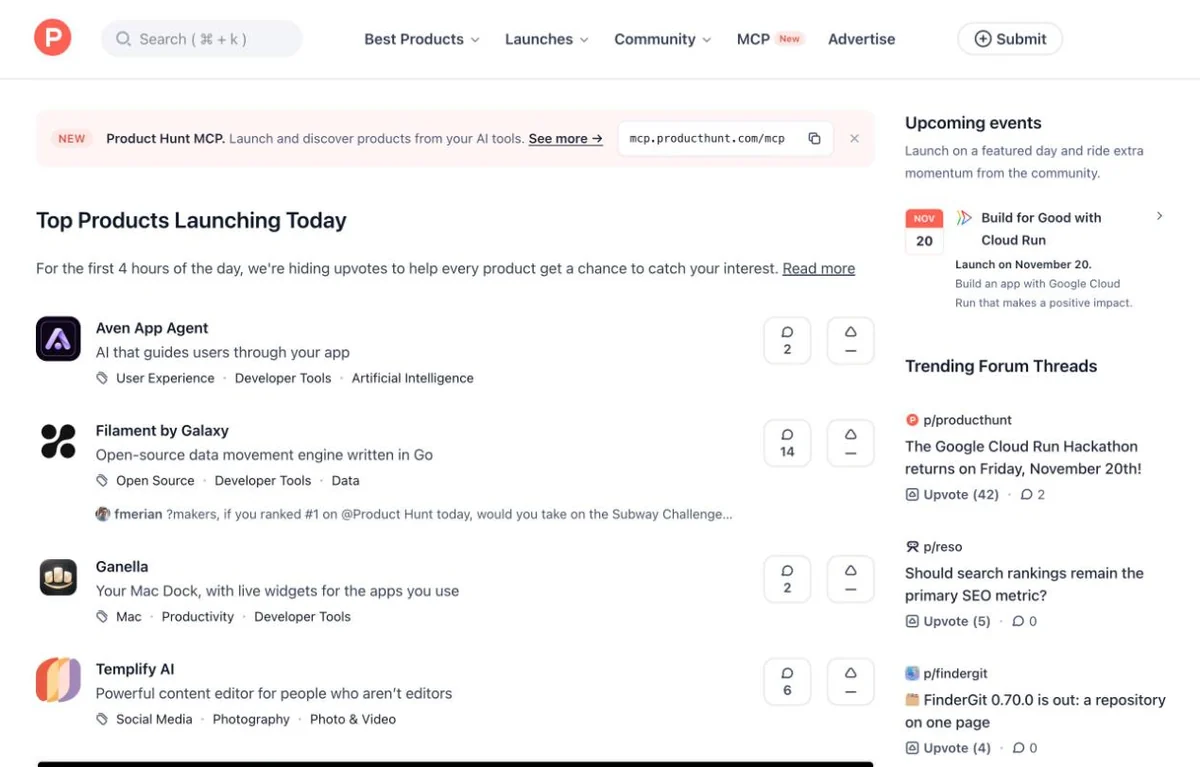
Product Hunt is the best-known launch platform for software. Every launch goes live at 12:01 a.m. Pacific Time on the day you schedule, and you can schedule from tomorrow up to 30 days ahead. Its team reviews every launch and picks which ones to feature on the homepage. Featured launches then compete for the day’s ranking and for Product of the Day.
Points come from upvotes and other engagement, and the ranking also weighs comments, time since launch and other signals. Product Hunt does not publish the formula, so that it is harder to game. Votes from established, active members count for far more than votes from new accounts. That is why a borrowed crowd does little. Paid upvotes can even get a launch removed and the account banned.
Competition has grown. Product Hunt counted 2,345 launches in the second quarter of 2026, up from 1,508 a year earlier. AI was the biggest category with 1,111 launches, and more than 61% of its makers were launching for the first time. Across all categories, the average launch collected 190 upvotes.
- It is free. Submitting a launch, commenting and winning Product of the Day cost nothing.
- Hunt it yourself. You do not need a famous hunter, because Product Hunt says who posts a launch does not affect its ranking.
- Write the first comment. Explain why you built the product and what you want feedback on.
- Relaunch with every major update. If your last launch was less than two months ago, you need to request the relaunch first.
SaaSHub
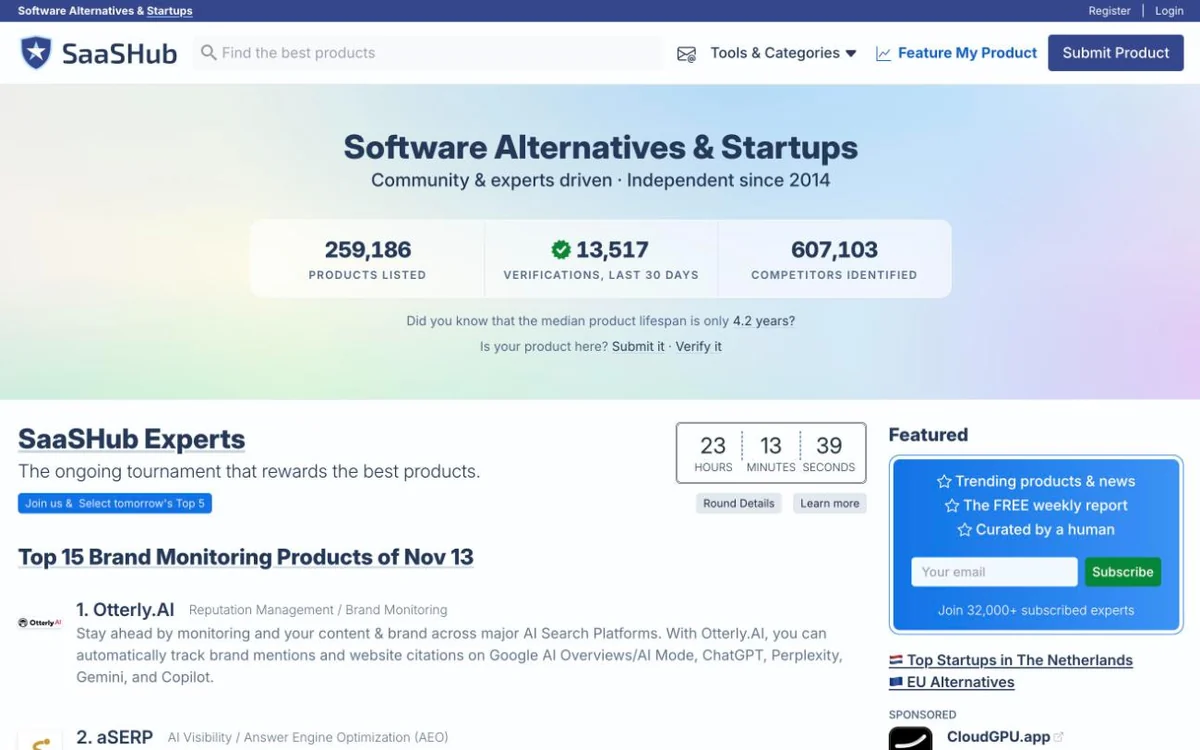
SaaSHub is a site for software alternatives that has run independently since 2014. People land on it when they search for an alternative to a tool they already know. That makes it useful after launch day, because it reaches buyers who are actively comparing. On 13 November 2026, its homepage counted 259,186 products, 607,103 identified competitors and 13,517 verifications in the previous 30 days.
- Submit for free. Use the Submit Product button, and then verify the listing so you can manage its details.
- Answer the questions. SaaSHub asks verified makers to fill in a short Q&A from the product’s management page, which keeps the listing accurate.
- Choose your competitors with care. Your page shows up as an alternative to the products you sit next to. So pick the ones your buyers already know.
- Follow the tournament. SaaSHub Experts runs a new round every day, each with a top 15 in one category. It is a small but steady source of attention.
- Paid placement is optional. A Feature My Product option exists, but the free listing is where to start.
Gappsy
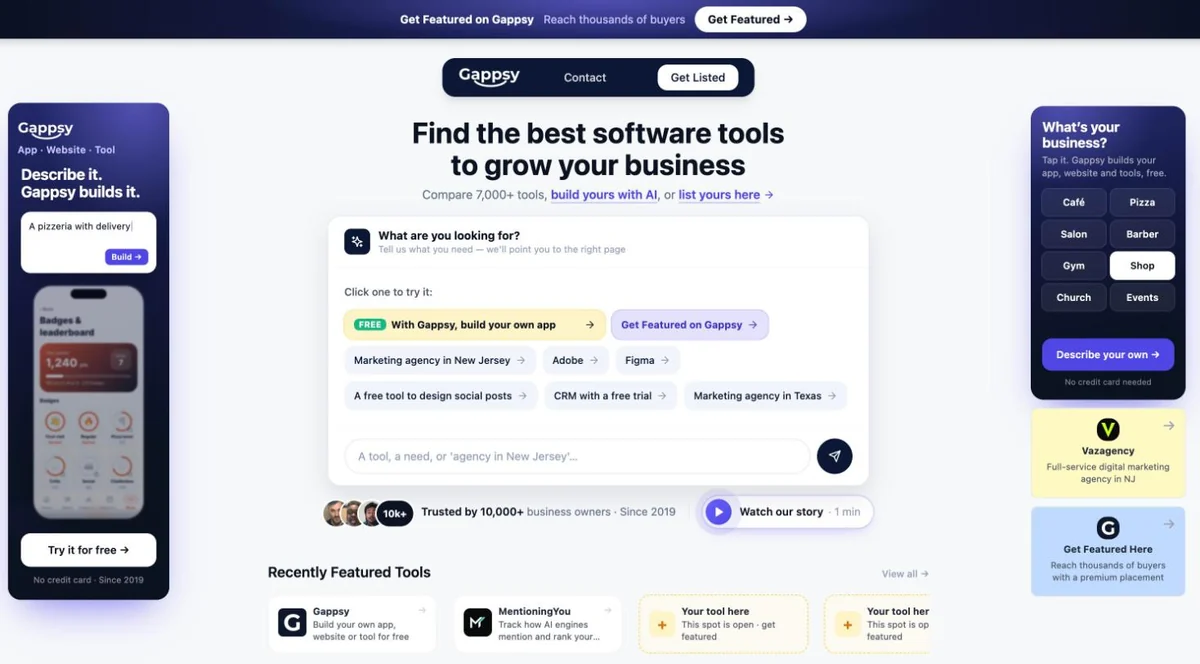
Gappsy is a software directory for business owners. Its homepage invites visitors to compare more than 7,000 tools, in more than 70 categories from CRM and marketing to AI. Besides the tool profiles, it publishes head-to-head comparison pages that cover pricing and features. It also offers an AI app builder, which suits founders who have not built their product yet.
- Listing is free. On its List Your Product page, you enter your product’s website and submit it.
- Comparisons work in your favour. Buyers who compare two tools are close to a decision. Therefore, being one of those two is worth more than a mention in a long list.
- Featured spots are available. Gappsy also sells premium placements on its homepage for makers who want more reach after launch.
- Keep the facts in sync. Use the same tagline, pricing and screenshots as on Product Hunt and SaaSHub, so buyers see one consistent story.
After the launch: turn the spike into a system
The week after launch decides whether the spike was worth it. Attention drops fast, so use what you have while it is fresh.
- Measure by source. Give every platform and every video its own tagged link, for example with utm_source and utm_campaign. Otherwise your analytics will say “YouTube” and you will never know which video sent the buyer.
- Repurpose the best questions. Every good question from launch day can become a post, a short video or an answer in your help centre.
- Keep a weekly rhythm. Post three times a week on your main platform, every week. Once the launch is over, consistency beats intensity.
- Follow up with signups. Email the people who signed up but did not activate, and ask what stopped them.
- Plan the next launch. Write down what worked. Then give the next major update its own launch, as Lovable does.
Finally, track a small set of numbers: signups per channel, activation within seven days, and paying customers per channel after 30 days. Views and followers are useful signals, but they are not the result.
Mistakes that sink SaaS launches
- Launching to nobody. Without a waitlist or a launch list, a launch depends on luck.
- A video about the company instead of the user. Nobody shares a mission statement. People share a result they want for themselves.
- Too many messages at once. Keep one promise per video, and save the feature list for your website.
- Buying votes on launch platforms. Product Hunt detects paid and low-quality engagement, and the penalty can be removal.
- Disappearing after day one. Comments left unanswered on day two cost you the people who arrive late.
- No tracking. Without tagged links, you cannot tell which post worked, so you cannot repeat it.
Frequently asked questions
How long before launch should I start posting on social media?
Six to eight weeks is a realistic minimum. That gives you enough posts to find your voice and enough followers for a first wave. If you can start three months ahead, even better.
Which social media platform is best for launching a SaaS?
The one where your buyers already spend time. For B2B software, that is usually LinkedIn and X. For consumer and creator tools, short video on TikTok, Instagram and YouTube Shorts tends to reach more people.
How long should a SaaS launch video be?
Aim for 45 to 90 seconds on social media. A 2026 study of 194 launch videos on X found a median length of 52 seconds, and clips under 15 seconds did worst. A longer demo of two to five minutes belongs on YouTube.
Is Product Hunt still worth it in 2026?
Yes, if you prepare. It is free, and a featured launch puts you in front of people who like trying new tools. Competition is higher than ever, though, so treat it as one channel of your launch rather than the whole launch.
Should I buy upvotes or followers for my launch?
Never buy votes on Product Hunt or similar platforms. It breaks their rules and can get your launch removed. TikTok and Instagram do not allow fake engagement either, and bought likes never replace a video people want to watch. Our article on whether buying TikTok likes works explains what they can and cannot do.
Where should I list my SaaS after launch?
Start with Product Hunt for launch day, then add SaaSHub and Gappsy for the months after. Use the same name, tagline, pricing and screenshots on each, and update all three when you ship a major release.
The short version
Build an audience on one or two platforms for six to eight weeks. Then make a launch video of about a minute that opens on a face, shows the product working and says what makes it different. Launch on a day your team can be online, answer every comment and never ask for votes. Afterwards, list the product on Product Hunt, SaaSHub and Gappsy, tag every link, and treat each major update as your next launch.