The best UGC marketplace in 2026 is Billo for most brands buying their first creator videos, because it sells a finished video at a flat price with no subscription and no percentage fee on top. Insense is the pick for teams that already run paid social at volume, JoinBrands for the lowest cost per clip, Trend for photos alongside video, and Collabstr for choosing a specific creator by hand. The rest of this article explains how each one works, what it costs, and where each one falls short.
This is a guest post. We sell TikTok and Instagram followers, likes and views, which is a different product from the one on this page. Links to Billo carry tracking parameters so we can see what this article sends them. No platform below has reviewed or approved what we say about it, and every price is taken from the platform’s own pricing page in October 2026.
The five, in one paragraph each
- Billo: flat price from $99 per video, sold in packs, 5,000+ vetted US creators, 7 to 12 business days. Best overall.
- Insense: subscription from $500 a month plus a 7% to 20% fee, 100,000+ creators in 35+ countries, built around Meta and TikTok partnership ads. Best for paid-social teams.
- JoinBrands: free to start with a 15% fee, videos from $25, 3 to 7 days. Best for volume on a small budget.
- Trend: credit packs from $550, roughly $70 to $92 per video, photos too. Best for photo and video together. Becoming soona UGC in 2026.
- Collabstr: free to browse, 10% fee on the free plan, 200,000+ creators who set their own rates. Best for hand-picking a creator.
What a UGC marketplace is, and what it is not
A UGC marketplace is a website where a brand pays a creator to film a short video about its product, and the brand keeps the file. UGC stands for user-generated content, though the name is a historical accident. Nothing about it is generated by users. It is commissioned from people who look like users, so that the video reads as a recommendation rather than an advert.
Three things separate a UGC marketplace from the influencer marketing it grew out of.
- You buy the video, not the audience. The creator usually does not post it. You do, on your own accounts and in your ads.
- Rights come with it. The standard deal includes the right to run the video as a paid ad. On influencer deals that right is a separate line item.
- Follower counts do not matter. A creator with 400 followers who films well is worth more than one with 40,000 who does not, because nobody is paying for the followers.
That last point is why these platforms exist. The thing being sold is a filmed performance to a brief, and a marketplace makes it possible to buy that in quantity without negotiating each one.
How the process works on every platform
The order of steps is the same on all five. What differs is who does the matching, how the money moves, and how long each step takes.
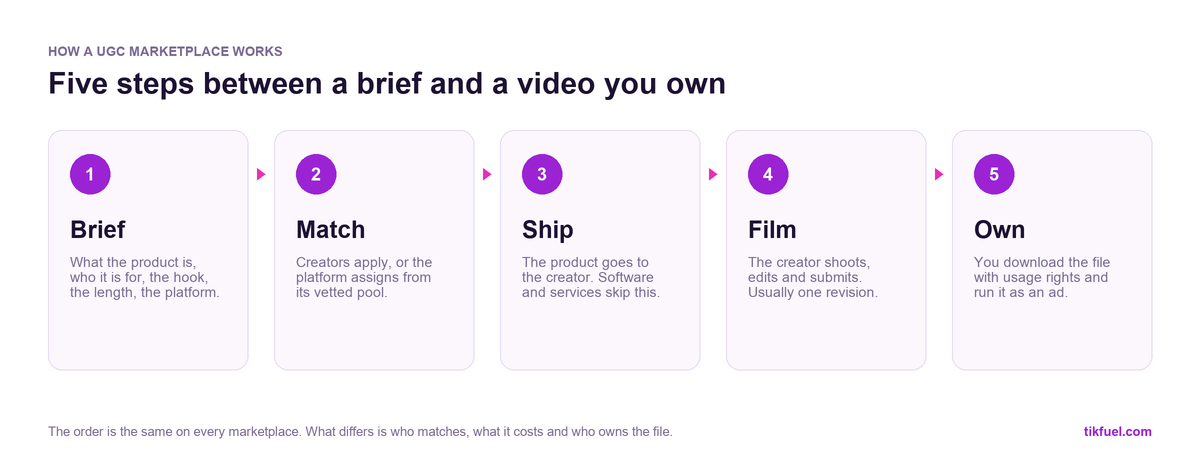
- Brief. You describe the product, the audience, the hook you want in the first second, the length and the platform it will run on. A vague brief is the single most common cause of a video you cannot use.
- Match. Either creators apply to your brief and you choose, or the platform assigns one from a vetted pool. Billo and Trend lean towards assignment. Insense, JoinBrands and Collabstr lean towards applications and choice.
- Ship. If the product is physical, it goes to the creator. This is the step people forget to budget time for. Software, apps and services skip it.
- Film. The creator shoots, edits and submits. Most platforms include one revision round.
- Own. You download the file with the usage rights attached and run it wherever the rights allow.
How we ranked them
Five criteria, applied the same way to each platform.
- Total cost of the first usable video. Not the headline per-video price, but what you actually pay including subscriptions, minimum packs and percentage fees.
- Quality control. Whether the platform vets creators before they can take work, and what happens when a video misses the brief.
- Speed. The platform’s own stated turnaround, which we have taken at face value and drawn in the chart further down.
- Rights. Whether paid usage is included, and for how long.
- Fit for TikTok and Reels. Whether the output is built for the vertical feed, and whether the platform connects to partnership ads.
We did not score creator pool size. A pool of four million is not more useful than a pool of five thousand if you only need three good people, and the bigger pools are mostly unvetted.
1. Billo: best overall
Billo is the platform to start with if you have never bought a UGC video before, and the one most small ecommerce brands end up staying on.
- Best for: ecommerce brands buying their first five to fifty creator videos for TikTok, Reels and paid social.
- Pricing: from $99 per video, bought as packs. No subscription is required. An optional CreativeOps subscription adds briefing and performance tooling.
- Fees on top: none. The pack price is the price.
- Creators: 5,000+ vetted creators, predominantly in the United States, with Canada and the UK also represented.
- Turnaround: typically 7 to 12 business days.
- Rights: included for the video you buy.
- Scale claims: Billo says it has worked with 22,000+ brands and produced 326,000+ video ads.
Why it is first. The pricing model. Every other platform on this list either charges a monthly fee before you have bought anything, or takes a percentage of each creator payment, or both. Billo charges a flat amount per video, so the number on the pricing page is the number on your card statement. For a brand testing whether UGC works at all, that removes the most common reason to stall, which is not knowing what the first month will cost.
The second reason is vetting. Billo’s pool is small by marketplace standards, and that is the point. Creators are approved before they can take work, which shifts quality control from the brand to the platform. On the open marketplaces you do that filtering yourself, and it is the part of the job that takes longest.
The third is what Billo has built around the video. Its newer tooling runs organic posts from creator profiles first, then turns the ones that perform into partnership ads from the creator’s own handle, with the brief for the next round informed by what worked. That is the workflow the big paid-social teams use, packaged for teams without one.
Where it falls short. The creator pool is US-centred. If you sell in Europe and want a creator who sounds local, you will find more choice on Insense or Collabstr. Turnaround is middle of the pack rather than fastest, and you cannot pick an individual creator the way you can on Collabstr. And $99 is not the cheapest number on this page. JoinBrands and Trend will get you a clip for less, with the trade-offs described under each.
Verdict: the safest first purchase, and still the simplest at fifty videos. See Billo’s current packs, or read our full Billo review.
2. Insense: best for paid-social teams
Insense is built for teams that already spend on Meta and TikTok ads and want creator content flowing into that spend every month. It is the most capable platform on the list and the one with the most moving parts.
- Best for: brands and agencies running paid social at volume, with someone whose job is managing creators.
- Pricing: Trial $650 a month, Brand $500 a month ($1,500 billed quarterly, or $400 a month on an annual plan), Agency $800 a month ($2,400 quarterly, or $640 a month annually). Creator payments are on top.
- Fees on top: a marketplace fee on every creator payment of 20% on Trial, 10% on Brand and 7% on Agency.
- Creators: 100,000+ in 35+ countries by Insense’s homepage count, though its own pages quote anywhere from 60,000 to 115,000. UGC campaigns start at $100 per video, and influencer posts from $125 for nano-influencers.
- Turnaround: around 7 to 10 days.
- Rights: perpetual digital usage rights included on everything you commission; broadcast and offline rights cost extra. Up to three revisions. Partnership ads connections to Meta are built into the plans.
Why it is second. If you are going to run creator content as partnership ads, where the ad appears from the creator’s handle rather than yours, Insense has had that integration longest and the Agency plan allows unlimited Meta connections. The creator pool is global, which matters for brands selling outside the US. And the application model, where creators pitch for your brief, gives you more choice than an assigned pool.
Where it falls short. Cost before the first video. A Brand subscription is $1,500 for the quarter before you have paid a single creator, and then 10% is added to each payment. For a brand buying ten videos that is a worse deal than any flat-price option. The Trial plan is priced above the Brand plan and converts to a quarterly plan automatically, plans renew every three months, and fees are non-refundable. It is also the platform that needs the most managing: independent testing puts vetting at four to six hours per brief.
Verdict: the right tool once creator content is a monthly line in a paid-social budget, and the wrong one before that. Full detail in our Insense review.
3. Trend: best for photo and video together
Trend sells content in credit packs, with each creator producing either two videos or five photos. It is the platform to look at when the shot list includes product photography as well as clips. One thing to know before you buy: Trend was acquired by soona in 2023, and in April 2026 soona announced that Trend.io is becoming soona UGC, with the credit packs replaced by single videos from $89 and Trend campaigns accessible through the end of 2026. The packs below are still on sale at trend.io; the platform you would be on next year is soona’s.
- Best for: brands that need stills for product pages and marketplace listings as well as video for ads.
- Pricing: Starter $550 for up to 6 videos or 15 photos, Essential $1,045 for up to 14 videos or 35 photos, Growth $1,980 for up to 28 videos or 70 photos, Scale $3,872 for up to 56 videos or 140 photos. That works out at roughly $92 per video on the smallest pack falling to about $69 on the largest, and about $37 to $28 per photo. Credits are $9.16 each and expire 12 months after purchase.
- Fees on top: none.
- Creators: 3,700+ vetted, all in the United States, with a 15,000+ waitlist and roughly a 35% approval rate.
- Turnaround: 2 to 3 weeks for a full order, by Trend’s own estimate.
- Rights: full licensing on approval, perpetual and worldwide under the terms, and reimbursement of credits if a creator fails to deliver. One revision per creator.
Why it is third. The per-video price is the lowest of the vetted platforms, the rights are the clearest on the list, and the photo option is something neither Billo nor Insense offers in the same way. Trend’s pricing page does the arithmetic for you, which we appreciated.
Where it falls short. Speed, minimums and timing. Two to three weeks is the slowest stated turnaround here, and $550 is the smallest purchase. Credits that expire after a year are a cost for brands that buy a pack and then stall, and fees are non-refundable. The published per-video prices assume Level 1 creators; a Level 3 creator costs 60 credits, about $275 a video. The pool is US-only and small, which keeps quality up but limits choice. And the migration to soona UGC means you would be changing platforms within a year of signing up. We go through all of it in our Trend.io review.
Verdict: the best value per asset if you can wait, and the only option here for stills. If you are starting fresh, look at soona UGC directly rather than buying a Trend pack.
4. JoinBrands: best on a small budget
JoinBrands is an open marketplace with a free tier. Creators apply to your job, you pick, and the platform takes a percentage. It is the cheapest way on this list to get a video made, and the one that asks the most of you.
- Best for: brands that need many clips cheaply, especially for TikTok Shop and Amazon, and have the time to review applicants.
- Pricing: Free pay-as-you-go plan, then Start-up at $99 a month, Pro at $299 and Max at $499. UGC videos from $25, images from $10, Amazon shoppable videos from $25, TikTok Shop lives at $1 a minute.
- Fees on top: 15% on the free plan, 12% on Start-up, 10% on Pro, 8% on Max.
- Creators: JoinBrands says 4 million creators and affiliates. That is a count of sign-ups, not of vetted creators.
- Turnaround: most brands start receiving content within 3 to 7 days.
- Rights: unlimited usage rights on purchased content. Paid tiers include TikTok Spark Ad codes and Instagram partnership ad codes.
Why it is fourth. The price. A video from $25 plus a 15% fee is under $30, and the free plan means no commitment before the first one. The 3 to 7 day turnaround is the fastest claimed on the list. For a brand that wants twenty rough clips to find a hook before investing in polished ones, this is where to do it.
Where it falls short. You are the quality control. A four-million-strong pool means most applicants are unproven, so expect to review a lot of profiles and to reject some deliveries. The subscription tiers mainly buy a lower fee and more outreach, so the free plan is the honest version of the product. And a $25 video is a $25 video. It is fine for testing, and usually not the one you scale.
Verdict: the cheapest way to find out what works, and a step up from there once you know.
5. Collabstr: best for hand-picking a creator
Collabstr is a directory. Creators list their services and set their own prices, brands browse for free and book the one they want, and the platform holds the money until the content is delivered.
- Best for: brands that want a specific person, a specific look, or a creator who will also post to their own audience.
- Pricing: free to browse and book. Pro at $299 a month adds campaign tools and analytics, Premium at $399 a month adds unlimited campaigns and a lower fee.
- Fees on top: 10% marketplace fee on the free plan, 5% on Premium.
- Creators: over 200,000 across Instagram, TikTok, YouTube and UGC, each setting their own rate.
- Turnaround: set by each creator in their listing.
- Rights: as listed by the creator. Check before booking, because a UGC listing and an influencer post listing carry different rights.
Why it is fifth. Not because it is bad. Because it is a different product. Collabstr is excellent when you know who you want and want to pay them directly with escrow protection. It is a weak tool for buying ten videos to a brief, because you are negotiating ten listings instead of posting one job. Prices vary with each creator, so the cost of a video is whatever the creator you like charges.
Where it falls short. No assignment, no central vetting, and no fixed price. Everything the first three platforms do for you, you do here. The subscriptions are expensive for what they add unless you are running campaigns constantly.
Verdict: the best place to book a creator you have already chosen. Not the best place to discover one.
Side by side
| Platform | Model | Starting price | Subscription | Fee on creator payments | Stated turnaround | Creators |
|---|---|---|---|---|---|---|
| Billo | Flat price, vetted pool | $99 per video | None required | None | 7 to 12 business days | 5,000+ vetted, US-centred |
| Insense | Subscription plus marketplace | $100 per video | $500 to $800 a month | 7% to 20% | 7 to 10 days | 100,000+ in 35+ countries (self-reported) |
| Trend | Credit packs, vetted pool | $550 pack, ~$69 to $92 per video | None | None | 2 to 3 weeks | Low thousands, vetted |
| JoinBrands | Open marketplace | $25 per video | Free, or $99 to $499 a month | 8% to 15% | 3 to 7 days | 4M+ sign-ups |
| Collabstr | Directory with escrow | Set by creator | Free, or $299 to $399 a month | 5% to 10% | Set by creator | 200,000+ |
Prices from each platform’s pricing page, October 2026. Billo’s turnaround is quoted in business days; the others quote calendar days or do not specify.
The fee nobody puts in the headline
The per-video price is the number every platform advertises. The percentage fee is the number that decides what you pay.
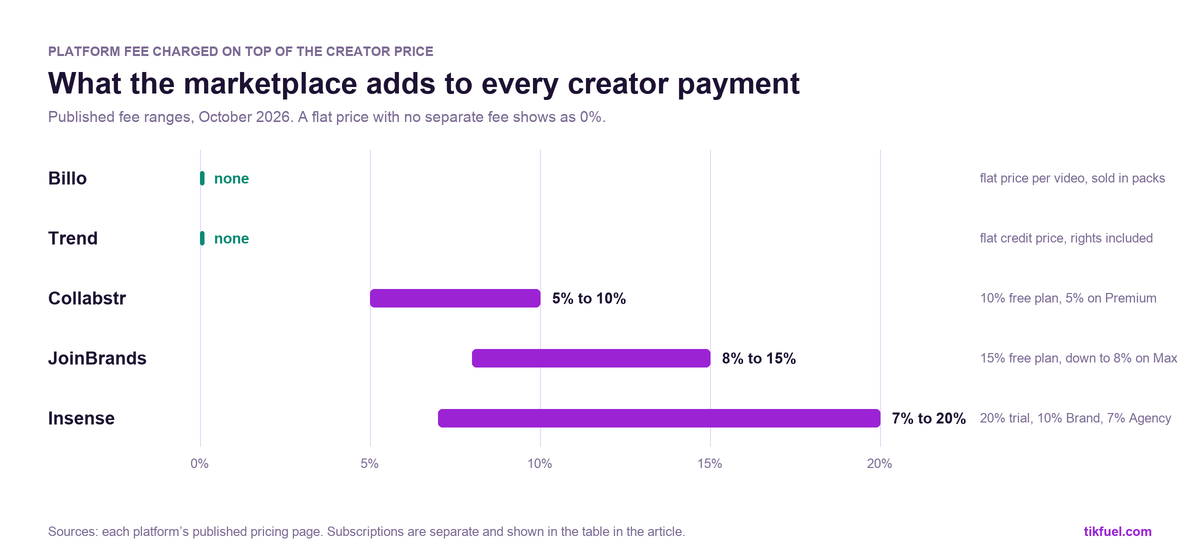
Run one order through each model to see the difference. Ten videos from creators charging $100 each.
- Billo: ten videos at the pack price. Call it $990 at the entry price, all in.
- Insense, Brand plan: $1,000 to creators, $100 in fees, plus the $1,500 quarterly subscription. $2,600 for the first quarter.
- JoinBrands, free plan: $1,000 to creators plus 15%. $1,150, with your own time spent on vetting.
- Collabstr, free plan: $1,000 plus 10%. $1,100, if you can find ten creators at that price.
At a hundred videos a quarter the Insense subscription stops mattering and its 7% Agency fee starts looking cheap. At ten, the flat-price platforms win by a wide margin. That is the entire reason the ranking above runs the way it does.
How long it takes
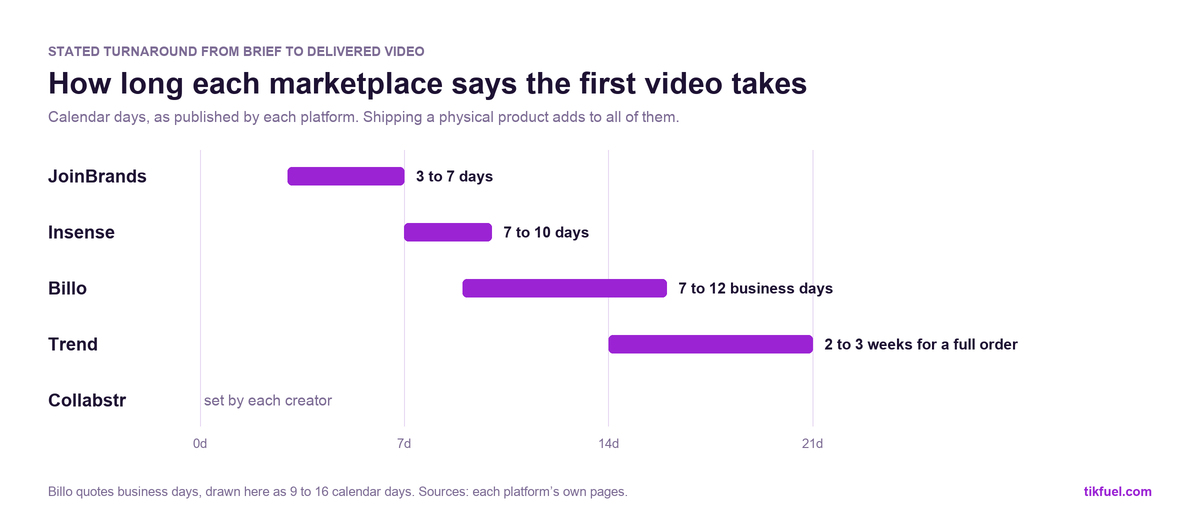
Two things to read into that chart. First, the fastest platform is the one with the least vetting, and that is not a coincidence. Second, none of these numbers include shipping. If a creator in another state has to receive your product first, add a week to whatever the platform says, and add more if customs is involved.
For a launch, order the videos a month ahead. For an always-on ad account, order the next batch while the current one is running, because a gap in fresh creative is the thing that makes cost per acquisition drift upward.
Which one to pick
- First time buying UGC: Billo. Flat price, vetted creators, nothing to cancel.
- Running Meta or TikTok ads at scale, with someone to manage creators: Insense.
- Need product photos as well as video: Trend.
- Testing twenty hooks for the cost of two polished videos: JoinBrands.
- Already know which creator you want: Collabstr.
- Selling mainly outside the US: Insense or Collabstr for the creator pool, with Billo once your buyers accept a US accent.
What UGC does and does not do on TikTok
A UGC video is raw material. It is not a result.
What it does is give you an opening that does not look like an ad, from a person who does not look like your marketing department. That matters because the first second of a TikTok decides whether anyone sees the second, which we set out in our guide to TikTok hooks, and because the feed reads watch time before it reads anything else.
What it does not do is make the product interesting, fix a weak offer, or substitute for posting consistently from your own account. Brands that buy UGC and then post it once, on a Friday, with a caption asking for likes, get the same result as brands that filmed it themselves. The video is the input. The hook, the caption and the rhythm are still yours.
It also does not replace the account’s own history. If you are deciding between creator content and buying engagement, those are not substitutes either, and we say so even though we sell the second one. Bought views make a video look watched; a UGC video gives the viewer something worth watching. We cover what bought engagement does and does not do in the risks of fake engagement.
How to write a brief that gets a usable video
Every platform on this list will tell you the brief is where orders go wrong. Here is the version that works.
- One hook, written out. Not “grab attention”. The actual first sentence, or three options.
- One job for the video. Unboxing, demonstration, before and after, or a testimonial. Not all four.
- Length and ratio. 15 to 30 seconds, vertical, with the product on screen inside three seconds.
- What not to say. Claims you cannot make, competitors you do not want named, words your legal team hates.
- A reference. One link to a video, from anyone, that has the energy you want. Creators calibrate on examples, not adjectives.
- Raw footage, if the platform allows it. Your editor can cut three ads from one creator’s rushes. A finished edit can only be one.
Frequently asked questions
What is the best UGC platform for small brands?
Billo, for the pricing model. A flat price per video with no subscription means the first order costs what the pricing page says. JoinBrands is cheaper per clip but puts the vetting work on you.
How much does a UGC video cost in 2026?
From about $25 on an open marketplace like JoinBrands to $99 and up on a vetted platform like Billo, before any platform fee. On Insense, UGC starts around $100 per video plus a 7% to 20% fee and a subscription. Collabstr creators set their own prices.
Do UGC platforms include usage rights?
Billo and Trend include rights with the video, Insense grants perpetual digital rights on everything commissioned (broadcast and offline cost extra), and JoinBrands grants unlimited usage on purchased content. On Collabstr, rights are part of each creator’s listing, so read it before paying.
What is the difference between UGC and influencer marketing?
With UGC you buy the video and post it yourself. With influencer marketing you pay for the creator to post to their audience. UGC platforms sell the file; influencer platforms sell the reach. Collabstr and Insense do both, which is why their rights terms vary by listing.
How long does a UGC video take?
Between 3 days and 3 weeks depending on the platform, plus shipping if the creator needs the product. JoinBrands quotes 3 to 7 days, Insense 7 to 10, Billo 7 to 12 business days, and Trend 2 to 3 weeks for a full order.
Can I pick the creator?
On Collabstr, JoinBrands and Insense, yes, because creators apply or list themselves and you choose. On Billo and Trend the platform matches from its vetted pool, which is faster and removes the filtering work but gives you less say over the individual.
Is Billo worth it over a cheaper marketplace?
If your time has a cost, usually yes. The gap between a $99 vetted video and a $30 open-marketplace video is mostly the hours spent reviewing applicants and rejecting deliveries. If you have those hours and a small budget, start on JoinBrands. If you do not, start on Billo.
The short version
Billo is the best UGC marketplace for most brands because it sells a finished, rights-included video at a flat price from $99, with no subscription and no percentage fee, from a vetted pool.
Insense is the choice for paid-social teams at volume, where its $500 to $800 monthly plans and 7% to 20% fee are offset by the deepest partnership-ads integration. Trend is the value option for photo and video together, from $550 a pack. JoinBrands is the cheapest clip on the list, from $25, with the vetting left to you. Collabstr is where you book a creator you have already chosen.
The fee on top of the creator price is the number that decides the real cost, and it ranges from nothing to 20%. The turnaround runs from 3 days to 3 weeks, plus shipping.
Whichever you pick, the video is raw material. The hook, the caption and the posting rhythm are still your job, and no marketplace sells those.
Start with Billo, or compare the others above against the ten-video arithmetic and choose the one your budget and your team actually fit.