Insense is a creator marketplace and campaign platform built for brands that run paid social every month and want UGC, influencer posts and partnership ads managed in one place, with Meta and TikTok partner status behind the integrations. It is the most capable platform in our ranking and the most expensive to start on: $500 to $800 a month billed quarterly, a 7% to 20% fee on every creator payment, a no-refund policy with one narrow exception, and four to six hours of your own vetting per brief. Our verdict is 4.0 out of 5 for the buyer it was built for, a DTC brand or agency with a creator programme to run, and a clear no for a brand ordering its first ten videos.
This is a sponsored review. We sell TikTok and Instagram followers, likes and views, which is a different product. Insense has not reviewed or approved the text. Every price, policy and figure below is taken from Insense’s pricing page, terms, refund policy and help centre, or from named third-party sources, all checked in October 2026, and the criticism is ours. Links to Billo, our number one pick in this category, carry tracking parameters.
Insense at a glance
- What it is: a vetted creator marketplace plus tooling for UGC, influencer posts, product seeding, affiliate deals and Meta and TikTok partnership ads.
- Price: Trial $650 for one month; Brand $500 a month billed quarterly ($1,500) or $400 a month annually ($4,800); Agency $800 a month quarterly ($2,400) or $640 a month annually ($7,680). Creator payments on top.
- Fee on top: 20% on Trial, 10% on Brand, 7% on Agency, added to each creator payment.
- Creator prices: “UGC campaigns start at $100 per video” and sponsored posts from $125 for nano-influencers, per the pricing page. Independent reviews put typical UGC at $100 to $300 per video.
- Creators: “100k+ responsive creators across 35+ countries” on the homepage, with a 7 million-influencer outreach database. Insense’s own pages quote figures from 60,000 to 115,000, so treat the count as a range.
- Turnaround: “Applications within 48 hours, content delivered in 14 days” advertised; two to three weeks end to end in practice.
- Revisions: up to three before you accept.
- Rights: perpetual digital usage rights on everything you commission; broadcast, offline and extended rights cost extra.
- Refunds: “charged funds are not subject to return”, with a single first-campaign exception.
- Public ratings: 4.5 on G2 from 374 reviews (brand-side); 3.6 on Trustpilot from 190 (mostly creator-side); 4.7 on the App Store from 3,100 ratings of the creator app.
- Best for: DTC brands with $50,000-plus monthly revenue and agencies, with someone whose job includes managing creators.
Our number 1 pick is Billo
Before you commit to a quarterly subscription, know that Billo sells a finished, rights-included video from $99 with no monthly fee and no percentage on top, from a pool the platform vets for you. For most brands buying their first fifty videos it is the simpler and cheaper route, which is why it ranks first in our comparison.
What Insense is
Insense Ads, Inc. is a New York company founded in 2016 and run by co-founder and CEO Danil Saliukov. It became a Facebook Marketing Partner in June 2020 and one of TikTok’s first creative marketing partners in December 2020, and it carries Meta Business Partner, TikTok Marketing Partner and TikTok Shop Partner badges on its homepage. Those credentials matter more here than on any other platform in our ranking, because the thing Insense sells is the ability to run ads from creators’ handles, and that depends on the integrations working.
Where Billo and Trend sell you a video, Insense sells you a system. The marketplace is one part. Around it sit campaign types for the jobs a paid-social team actually has: order UGC for ads, pay influencers to post, ship product to creators in bulk and see who activates, run affiliate deals on commission, and turn any of that into Meta Partnership Ads or TikTok Spark Ads. Insense says 3,500+ brands, apps and agencies use it and names Revolut, Monster Energy, Quince, Flo and Il Makiage among them.
How a campaign works
The workflow as Insense’s help centre describes it, with the timings the company and its reviewers attach to each step.
- Write the brief. Goals, content type and format, do’s and don’ts, deliverables, deadline, and the product delivery method: not required, shipment, or reimbursement. For TikTok Spark Ads you choose a licence duration here and ask the creator for the Spark code once the post is live.
- Creators apply, or you invite them. Insense’s FAQ says the first answers appear “within 2-3 hours after sending a brief” and a sufficient number within three days. Independent testing by UGC Roster found 25 to 40 applications per brief, of which three to five were usable in competitive niches such as skincare, supplements and home.
- Shortlist and negotiate in chat. You filter by location, category, gender, age, price and engagement, then agree price, deadline and shipping with each creator in the platform’s messaging module, which reviewers consistently rate as Insense’s best-built feature.
- Fund and ship. The creator’s fee is deducted from your loaded balance and held by Insense. If the product ships, the Shopify integration creates the order from inside Insense and tracks it.
- Receive, revise, approve. The creator uploads to the chat. You get up to three revisions. On approval you click “Finish deal” and the payment releases to the creator instantly.
- Activate. Approved videos go into partnership ads from the creator’s handle, for a partnership duration you choose, or you ask the creator to post and amplify from there.
UGC Roster’s accounting of the time involved is the number most reviews leave out: eight to twelve minutes per profile, four to six hours of vetting per brief, and roughly $600 a quarter in untracked labour for a brand running a brief a month. That is the price of choice, and it belongs in the comparison with platforms that vet for you.
Pricing in detail
| Plan | Price | Billing | Marketplace fee | Seats / brands | Creators and campaigns | Meta partnership connections |
|---|---|---|---|---|---|---|
| Trial | $650 | One month, then converts to Brand, billed quarterly | 20% | 1 / 1 | Up to 10 creators, 1 campaign | 1 |
| Brand | $500 a month | $1,500 a quarter, or $400 a month at $4,800 a year | 10% | 2 / 1 | Unlimited | 10 |
| Agency | $800 a month | $2,400 a quarter, or $640 a month at $7,680 a year | 7% | 4 / 5 | Unlimited | Unlimited |
The marketplace fee is added to every creator payment. Insense’s pricing page splits it as 5% for payment facilitation plus 5% for administration on the Brand plan; its older FAQ still quotes 15% to 20%, which is the figure to expect on Trial. Creator costs come out of a balance you top up separately, and you can pay creators in product alone, in which case you pay only the subscription. Paying by invoice requires a three-month minimum; by card there is none.
Three terms matter more than the headline numbers.
- The Trial is not a trial. It costs more per month than Brand, carries double the fee, and under the terms of service “any Subscription that is on a trial basis shall automatically upgrade to a Quarterly one”. It exists to move you onto a $1,500 quarterly commitment.
- Everything auto-renews. Brand and Agency renew every three months at the same price unless you tell support at least 48 hours before the renewal date. The most common one-star complaint on Trustpilot from the brand side is exactly this.
- There are no refunds. The refund policy reads: “charged funds are not subject to return. Insense follows the principle of fairness, therefore no exceptions are provided.” The one exception is a first-campaign money-back if fewer than five matching creators apply within seven days of a brief adjustment, voided if you try to contact creators off-platform. Unspent creator balance can be refunded on request; subscription and add-on fees cannot.
Managed services, where Insense runs the work, are priced on a separate page: a dedicated platform manager from $2,500 a month excluding creator fees; ready-to-go UGC from $3,500 for 8 videos from 2 creators, raw footage included; post-production from $500 for 15 videos; influencer scouting on custom quote.
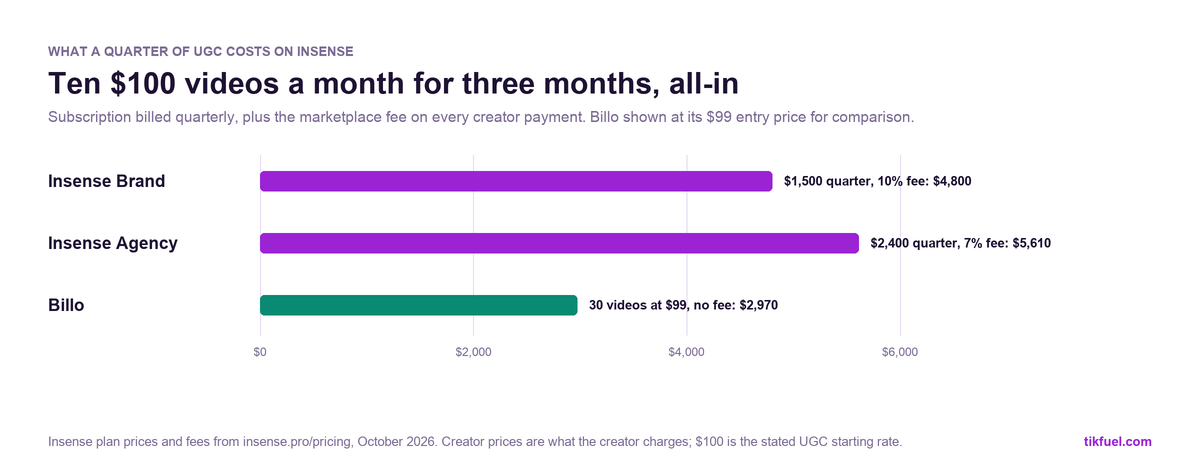
Put it together for a brand buying ten $100 videos a month: $1,500 for the quarter’s subscription, $3,000 to creators, $300 in fees, $4,800 all-in on Brand, before the four to six hours a month of vetting. The same thirty videos at Billo’s entry price are $2,970 with the vetting done for you. The gap narrows as volume rises, because the subscription is fixed and the Agency fee is only 7%, and it closes if you use the seeding, affiliate and partnership-ads features that Billo does not sell in the same form. Ecommerce Fastlane’s review draws the line at about $50,000 in monthly revenue or $3,000 in monthly ad spend; below that, it calls the fit conditional. We agree.
Our number 1 pick is Billo
If the arithmetic above is the deciding factor, Billo is where the flat price lives: from $99 a video, rights included, nothing renewing every quarter. We ranked it first for exactly this reason.
Creators: who they are and where
Insense’s pool is global and large, and its size is the least reliable number the company publishes. The homepage says 100,000+ across 35+ countries; the App Store listing says 115,000+; a G2 listing says 75,500; LinkedIn says 60,000 in 20 countries. The countries, at least, are consistent: the US, UK, Canada, Australia, Germany, France, Spain and Italy are all listed on the creator page, which is what makes Insense the strongest option in our ranking for brands selling outside the US.
Vetting is real but lighter than Billo’s or Trend’s. Creators need at least 1,000 followers and, depending on which Insense page you read, 500 median views or 1,000 views on TikTok, a portfolio of four or more videos across two content types and two verticals, and moderation “typically takes up to 72 hours”. Every marketplace creator has completed Insense’s education programme and uses its app. That is a bar; it is not a bar that guarantees fit for your category.
Quality, as reviewers describe it, is deep in beauty, fitness, food and parenting and thin in B2B, industrial and luxury. The hands-on reviews agree the lever is filtering: UGC Roster’s skincare test found a 20% engagement lift simply from filtering applicants for beauty experience. Insense’s filters make that possible, and its application volume makes it necessary.
Creators are paid from the brand’s escrowed balance the moment the brand finishes the deal, then withdraw to PayPal in about four business days or bank in about seven. Insense says it has paid creators $8 million since 2020 on one page and $20 million on another. Creator-side sentiment is split: 4.7 from 3,100 App Store ratings, against Trustpilot complaints about being recruited by email and then rejected, about brands going quiet, and about low offers.
Turnaround
Insense advertises applications within 48 hours and delivery in 14 days. The realistic sequence from reviewers is three to five days for applications, two to three to choose and negotiate, five to seven to produce, and two to three for revisions: two to three weeks from brief to usable file, plus shipping where there is product. Influencer Marketing Hub puts delivery at five to fifteen business days. That is comparable to Billo once shipping is counted and faster than Trend’s two to three weeks per order.
Rights, revisions and disputes
Rights are included, and they are digital. Insense’s help centre states that “brands are granted perpetual digital rights” to copy, display, share, modify, create derivative works from and use the content on all digital marketing channels: social, websites, newsletters, blogs, email. The terms of service define it as a non-exclusive, royalty-free, worldwide, perpetual, sub-licensable, irrevocable licence for “Digital and CTV Rights”. Agencies can pass those rights to clients. What is not included is broadcast, offline and extended usage, which the creator terms say “require separate purchase”. For a brand running Meta and TikTok ads that is a distinction without a cost; for one planning TV or print, it is a line item.
Revisions are “up to three revisions before accepting the content”, per the pricing page. If the content still does not meet the brief after three, you can cancel the collaboration for non-compliance and Insense’s moderation team may arrange a refund of that creator’s fee to your wallet.
Disputes are decided by Insense: the terms say it “will resolve the dispute in its sole discretion based on the Campaign Brief and subsequent communications”. That sentence is the reason to write a precise brief and keep the negotiation in the chat. Off-platform contact with creators is prohibited for both sides, with a twelve-month non-circumvention on the creator.
Partnership ads depend on the creator granting access on their side. Insense’s one-click connection extensions make this easier than doing it manually in Business Manager, and it still fails on a share of orders. The connection count is set by plan: 1 on Trial, 10 on Brand, unlimited on Agency.
What the tooling does
- Meta Partnership Ads and TikTok Spark Ads. The core of the product. Insense cites Meta research that partnership ads deliver 53% higher CTR and 19% lower CPA than brand-handle ads; that is Meta’s figure, published by a vendor, and we have not seen the underlying study. The mechanism is sound: the ad runs under the creator’s name with a paid-partnership label, which is also what keeps it on the right side of the FTC’s endorsement guidance.
- Product seeding with Shopify. Link the store, create orders for creators from inside Insense, track delivery. Insense claims a greater-than-20% activation rate and cites Any Age Activewear’s 4x ROAS from seeding.
- Affiliate. Share links in chat and pay commissions through the platform; sample briefs use 10%.
- TikTok Shop. Creators apply within a day or two and provide Spark codes for shoppable videos.
- Performance dashboard. Spend, engagement and CPM with filters. Every independent review calls the analytics surface-level next to full influencer-marketing suites, and Ecommerce Fastlane notes they “lean toward audience demographics and campaign management metrics rather than direct ROAS attribution”.
Case studies
Insense publishes several with numbers; all are vendor-selected and brand-reported. The most detailed is Bones Coffee: nine creators, sixteen initial videos cut into nine concepts and eighteen hooks, 54 UGC ads in three months, a reported 2.16 ROAS and a 21% CTR. Wonderskin reports about 100 assets a month from roughly 70 creators on $3,500 to $5,000 a month in creator spend, which is the clearest published picture of what Insense looks like at the volume it is designed for. Jean-Patrique reports a 2.3x ROAS lift across 100-plus whitelisted ads.
What customers say, and who is saying it
Read Insense’s ratings by audience, because the three main sources are rating different things.
Brands, on G2: 4.5 out of 5 from 374 reviews, 72% five-star and 24% four-star, with no two- or one-star reviews at all. The praise is for ease of use, speed of creator matching and the brief and messaging system; brands say it saves significant time against sourcing creators by hand. The criticism is inconsistent creator quality in niche categories, analytics that stop at the surface, and the cost of subscription plus fee with no free plan.
Creators, on the app stores: 4.7 from 3,100 ratings on iOS and 4.3 from about 300 on Android. Positive reviews are about immediate payment and support; negative ones are about low offers and brands that take content and go quiet.
Mixed, on Trustpilot: 3.6 from 190 reviews, 55% five-star and 25% one-star, with Insense replying to 2% of negative reviews. Most reviewers are creators. The brand-side one-stars are almost all about the same thing: “they charge you every 3 month and don’t allow you to unsubscribe”, as one put it in April 2026. That is the auto-renewal clause working as written, and the fix is a calendar entry 48 hours before the renewal date.
Pros and cons
Pros
- The deepest partnership-ads integration available, with Meta and TikTok partner status since 2020.
- Global creator pool across 35+ countries; the best option in our ranking for non-US markets.
- Perpetual digital rights included on everything, with CTV covered.
- Up to three revisions, escrowed payment released only on approval.
- UGC, influencer posts, seeding, affiliate and TikTok Shop in one workflow, with Shopify handling the shipping orders.
- Applications in hours and a two-to-three-week cycle.
- Agency plan supports five brands and unlimited Meta connections.
Cons
- $1,500 a quarter before the first creator is paid, then 10% on top of every payment.
- The Trial costs more than Brand and converts to a quarterly plan automatically.
- No refunds on fees, and quarterly auto-renewal with a 48-hour notice window.
- Four to six hours of vetting per brief; quality varies by creator and thins outside beauty, food, fitness and parenting.
- Broadcast and offline rights cost extra.
- Surface-level analytics for a platform at this price.
- Disputes are decided at Insense’s sole discretion.
Who Insense is for
Use Insense if creator content is already a monthly line in a paid-social budget, you want ads running from creators’ handles, you sell outside the US, or you want influencer posts, seeding and affiliate deals managed in the same place as your UGC. The Agency plan is good value for an agency with several clients, and the managed ready-to-go package is a reasonable way to get eight ads with raw footage without staffing it.
Look elsewhere if you are buying your first batch of videos, you want to know the total before you start, nobody on your team has four hours a month to review applicants, or you simply need files to run yourself. That is most small brands, and for them a flat-price marketplace is the better answer.
Insense vs Billo
The two are not really competing for the same buyer, which is why both rank at the top of our list.
- Price model: Insense is subscription plus fee; Billo is a flat price per video. Below roughly fifty videos a quarter, Billo is cheaper all-in.
- Creators: Insense is global and larger; Billo is US-centred and vetted more tightly, with a Premium tier defined by delivery record.
- Rights: both include perpetual digital rights; Insense charges extra for broadcast and offline.
- Revisions: Insense three, Billo two.
- Your time: Insense expects you to vet; Billo’s matching does most of it.
- Beyond the video: Insense covers influencer posts, seeding, affiliate and TikTok Shop; Billo covers organic test posts, partnership ads and performance analytics through CreativeOps.
- Commitment: Insense renews quarterly with no refunds; Billo’s packs are one-time purchases valid for a year.
Our ranking puts Billo first because the buyer it suits, a brand buying its first fifty videos, is the most common buyer. Insense is second because for the next buyer up, it does things Billo does not.
Frequently asked questions
How much does Insense cost?
Brand is $500 a month billed quarterly ($1,500) or $400 a month on an annual plan, with a 10% fee on creator payments. Agency is $800 a month ($2,400 a quarter) with a 7% fee. The Trial is $650 for one month with a 20% fee and converts to Brand automatically. Creator fees start at about $100 per UGC video.
Does Insense include usage rights?
Yes, for digital use. Brands receive perpetual digital rights to everything they commission, covering social, web, email and CTV. Broadcast, offline and extended rights are purchased separately.
Can I get a refund from Insense?
Not on subscription or add-on fees. The refund policy allows one exception: a first campaign that attracts fewer than five matching creators within seven days of a brief adjustment. Unspent creator balance can be refunded on request.
How many creators does Insense have?
Insense’s homepage says 100,000+ in 35+ countries, with an outreach database of 7 million. Its own pages quote figures from 60,000 to 115,000.
How long does Insense take?
Applications within 48 hours and delivery in 14 days, as advertised. Two to three weeks from brief to usable file is realistic, plus shipping.
How many revisions does Insense allow?
Up to three before you accept the content. If it still misses the brief, you can cancel for non-compliance and request a refund of that creator’s fee to your wallet.
Is Insense worth it for a small brand?
Usually not for a first order. The subscription, fee and vetting time are built for teams producing creator content continuously. A flat-price marketplace is cheaper and simpler for a brand testing whether UGC works.
How do I cancel Insense?
Contact support at least 48 hours before the renewal date. Access runs to the end of the billing cycle. Plans renew every three months otherwise.
Verdict
Insense scores 4.0 out of 5 and takes second place in our ranking of UGC marketplaces. For a brand or agency running paid social at volume, with a global audience and someone to manage creators, it is the most complete platform available: partner-grade integrations, perpetual digital rights, escrow, three revisions and a creator pool that covers 35 countries. The subscription pays for itself at that scale. The reasons it does not score higher are the cost of entry, a trial that is really a quarterly commitment, a no-refund policy, surface-level analytics, and the hours it asks of you. For everyone below that scale it is an expensive way to buy ten videos.
Our number 1 pick is Billo
Not running paid social at that scale yet? Billo is the platform we recommend first: flat pricing, vetted creators, rights included, one-time packs instead of a renewing subscription, and a 4.0 in our own review.
Sources
- Insense: pricing, managed service pricing, refund policy, terms of service, creator terms, FAQ, for creators, payments and copyrights, partnership ads, Shopify integration
- Insense help centre: how campaigns work, usage rights, TikTok Spark Ads, creator payouts, creator eligibility
- Partner status: Facebook Marketing Partner, 2020; TikTok Creative Marketing Partner, 2020
- Reviews: G2, Trustpilot, App Store
- Independent: UGC Roster on creator quality and vetting time, Ecommerce Fastlane review, Influencer Marketing Hub review
- Case studies: Bones Coffee, case study index
- Context: TikTok Ads Manager on Spark Ads, Meta on creator collaboration, FTC Endorsement Guides FAQ