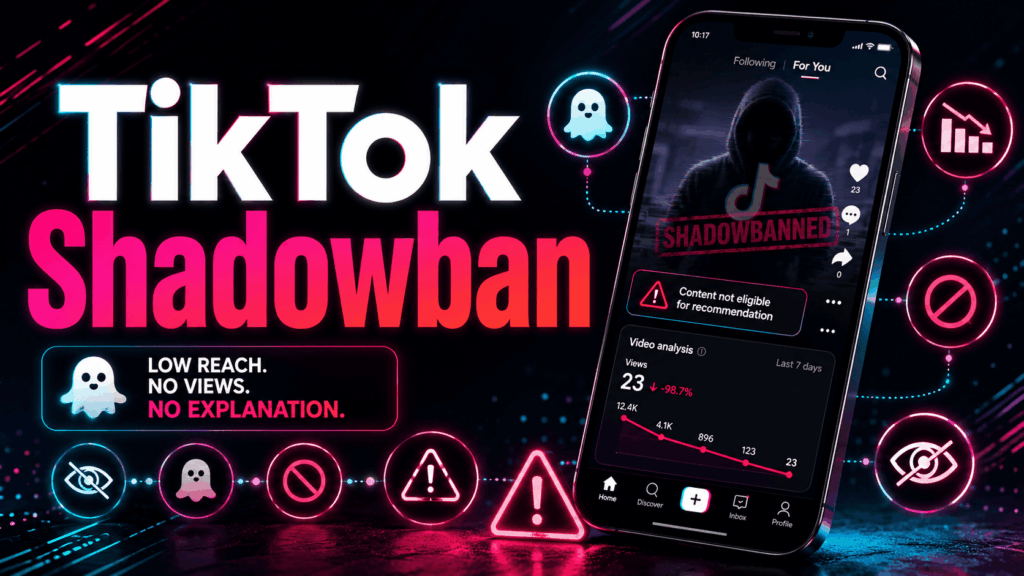
Your views fell off a cliff, the comments dried up, and somebody in a forum told you that you have been shadowbanned. It is a satisfying explanation because it is invisible: nothing to prove, nothing to check, no way to be wrong.
The useful thing to know is that TikTok publishes the real mechanism, and it also publishes where to look it up. The word shadowban does not appear in the Community Guidelines. What appears instead is a system for leaving certain content out of the For You feed, with rules that say what qualifies and a screen that tells you when it happened to you.
So this piece is about what is actually happening when reach collapses, how to check rather than guess, and what to do about the answer. For the wider picture of what moves your numbers, start with our guide to how to get more TikTok followers.
What TikTok says it does
In its For You feed Eligibility Standards, TikTok is direct about it: “We make ineligible for the FYF certain content that may not be suitable for a broad audience.” The categories are listed in the “FYF Ineligible” sections spread through the Community Guidelines.
Two lines from that same page are the ones nobody quotes, and they are the important ones.
The first: “Even if a video doesn’t make it to the FYF, people may still find it through search or by going to a creator’s account.” Ineligible is not deleted and not hidden. It is one distribution route closed while the others stay open, which is also why a video can sit at a few hundred views and still pick up traffic weeks later.
The second: “If a video isn’t getting many views, it also doesn’t necessarily mean it broke a rule.” That is TikTok saying plainly what most shadowban posts refuse to consider, which is that a video can simply not be good enough for the feed that day.
The case that looks most like a shadowban, and is not one
There is a third mechanism on that page, and it explains more real complaints than the ineligibility rules do. TikTok says it aims to prevent its systems “from repeatedly recommending content that could lead to a negative experience, such as extreme fitness or dieting, sexual suggestiveness, sadness, or overgeneralized mental health advice”.
Read that from the creator’s side. If your entire account is one of those subjects, the system is deliberately capping how often any single viewer is shown that kind of video. Nothing you posted broke a rule, nothing appears in Account status, and your reach is still being held down by design.
That is worth knowing before you rewrite your hooks for a month. If you make fitness, diet, sadness or mental health content, the ceiling is part of the product rather than a punishment, and the way around it is a wider range of subjects rather than a better opening on the same one.
You can check instead of guessing
This is the part that turns the question from folklore into a five minute job. TikTok’s own line is: “Creators can check TikTok’s analytics to see how their videos are performing, including if there were any made ineligible for recommendation.”
So there are two places to look, and both give you a real answer.
- Per video, in analytics. If a specific video was made ineligible for recommendation, that is shown to you rather than hidden from you. No guessing, no third party tester site.
- For the account, in Account status. Reachable from TikTok Studio and from the Safety Centre, it keeps a record of violations and their consequences, and it is where an appeal starts if something is wrong.
If both screens are clean, you are not being penalised, and every hour spent on shadowban theories from here is an hour not spent on the actual problem. Be honest with yourself about which answer you were hoping for.
The boring reasons reach collapses
Assume the screens are clean. Here is what is usually going on instead.
- One video did unusually well and the next ones did not. A breakout is an outlier by definition. Measuring everything afterwards against your best day makes normal look like punishment.
- The first two seconds got weaker. Success makes people relax into longer intros. The feed does not grade on a curve.
- The format got tired before you got bored of it. Audiences exhaust a joke faster than the person making it.
- You drifted niche. A new subject reaches a different audience, and the system has to work out who wants it. That takes several posts, not one.
- Volume dropped. Fewer posts means fewer chances, and reach is lumpy enough that a short run of flops proves nothing.
- The clip was not yours. Reposted, watermarked or lightly edited content from elsewhere is exactly what a recommendation system is built to filter out.
None of these are punishments. All of them look identical from the outside, which is why the shadowban story survives.
Things that genuinely do cost you reach
Some of it, though, is self inflicted, and it tends to be the part people leave out of the forum post.
TikTok’s deceptive behaviour policy prohibits using bots or scripts to increase likes or shares, and says automation built to bypass its systems can cost you content removals or an account ban. That covers engagement pods, comment bots and the automation tools that ran the whole thing from your account. If that last one is where you have been, we went through the category in what TikTok automation tools do to your account.
Spam behaviour counts too: the same comment pasted under fifty videos, mass following and unfollowing, DM blasts. So does duplicate posting, which is why deleting a flop and immediately reuploading it is the single most common way people make their own situation worse.
What removed engagement actually looks like when it goes, and what it does to a profile, we covered in the risks of fake engagement on TikTok.
What to do, in order
Work down this list and stop at the first thing that gives you an answer.
- Open Account status. Clean or not clean. If not clean, read what it says and appeal if it is wrong.
- Check the specific video in analytics for an ineligible-for-recommendation flag.
- Compare your last ten videos, not your best one. Look at the median. A drop from an outlier back to your own average is not a penalty.
- Post three more times before concluding anything. One video is noise, and the sample you are drawing conclusions from is too small.
- Leave the underperforming video alone. Deleting and reuploading resets nothing and looks like duplicate posting.
- Rewrite the opening. When the screens are clean and the pattern is real, the first two seconds are where the fix almost always is.
Where we stand
We sell followers, likes and views, so here is the part that costs us money to say: buying engagement is not a fix for a reach problem, and if your content is not being recommended, a purchased number does not change what the recommendation system thinks of the video. It just puts a bigger figure above a profile that is already underperforming, which is more obvious to a visitor, not less.
If you want an outside read on where the account actually stands before deciding anything, our TikTok Health Scan reads only public numbers and will tell you plainly when buying is not the answer.
Frequently asked questions
Does TikTok shadowban accounts?
Not under that name. TikTok makes certain content ineligible for recommendation in the For You feed, publishes which categories qualify, and shows creators in analytics when a video has been made ineligible. That is a documented and checkable process rather than a secret one.
How long does a TikTok shadowban last?
The question assumes a timer that does not exist. Content is either eligible for recommendation or it is not, and account level consequences are recorded in Account status with their own duration. Check those two screens rather than waiting out a number you read somewhere.
How do I know if I am shadowbanned on TikTok?
Look at Account status for the account and at analytics for the individual video. Third party shadowban checker sites have no access to either and are guessing from public view counts, which is exactly what you are already doing yourself.
Do banned hashtags get you shadowbanned?
TikTok blocks or redirects searches and hashtags associated with guideline violating content, so an affected tag stops helping. That is different from a penalty landing on your account, and swapping the tag out is the whole fix.
Should I delete a video that is not getting views?
Usually not. A video left up can still be found through search and through your profile, and reposting the same clip looks like duplicate content. Leave it and make the next one better.
The short version
The shadowban is a name people gave to a documented system: TikTok leaves some content out of the For You feed, tells you in analytics when it has done so, and records account level consequences in Account status. Check both. If they are clean, the problem is the video rather than a punishment, and the honest answer is a better opening, not a theory.