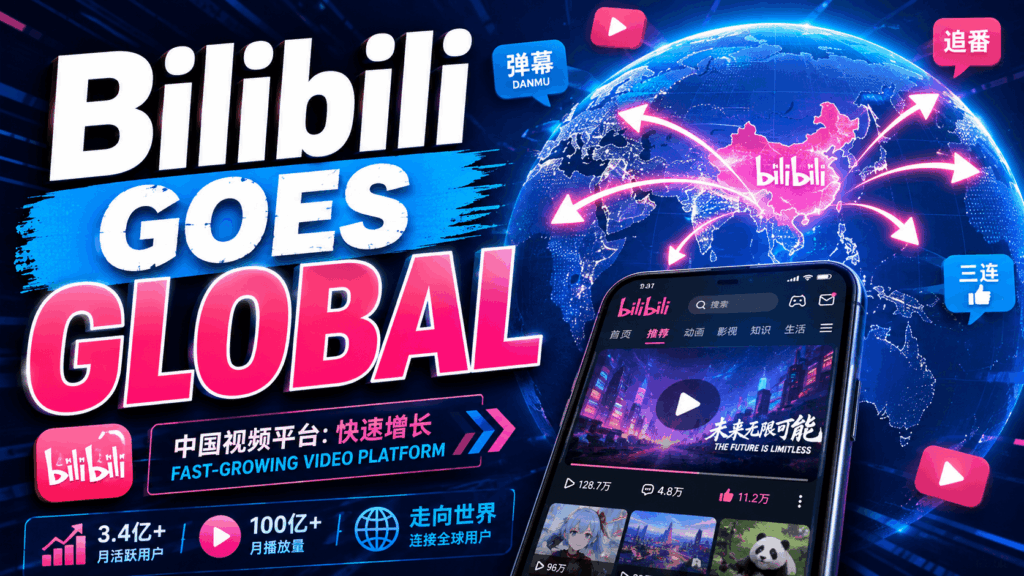
On August 19, 2026, a video platform that most people outside Asia have never heard of put a new app on Google Play. It passed five million downloads within days. The platform is Bilibili, and inside China it occupies roughly the space YouTube occupies everywhere else.
The relaunch came with one small change that explains the whole thing. Overseas users used to need a passport or another identity document before they could post anything. That requirement is gone. An email address is now enough.
Bilibili is not a startup and this is not a soft launch. It is a company with 371 million monthly users, listed in New York and Hong Kong, and it has started hiring staff in Los Angeles, London and four other cities. The target it has picked is YouTube.
What Bilibili actually is
Bilibili started in 2009 as a niche site for anime, comics and games. Its defining feature, then and now, is danmu, sometimes translated as bullet comments. Viewer comments fly across the video itself, anchored to the second of the video they were written at. Watch a clip a year after it was posted and you still see the reactions of everyone who watched before you, scrolling over the picture in real time. It turns a video into something closer to a room.
For years the site was deliberately hard to join. Full commenting rights required passing a membership test: 100 multiple-choice questions on anime, site culture and community rules, 60 correct inside an hour. The South China Morning Post covered the exam when it was still notorious enough to support a trade in answer keys on Taobao. That is close to the opposite of how a Western platform onboards anyone.
The important structural point is the shape of the content. Bilibili is long-form. Videos run for tens of minutes, people subscribe to channels, and the comment section is where the community lives. It is not a short-form vertical feed. China already has one of those, called Douyin, and it belongs to ByteDance, which also owns TikTok.
The scale is easy to underrate. Bilibili’s second quarter 2026 results, filed in August, report 116.5 million daily active users and 371 million monthly. Average time spent was 113 minutes a day. Quarterly revenue was RMB 7.94 billion, around 1.1 billion dollars, with advertising up 28% year on year and net profit up 55%.
Nearly two hours a day, per daily user, on long videos. That is the number that makes the rest of this story make sense.
What changed in August
Semafor reported the plan first, in an August 19 story on Bilibili’s global expansion, drawn partly from internal materials. The pieces that have been confirmed since:
- The international app is live on Google Play. iOS is announced as coming.
- Identity verification for overseas posting is gone. Sign-up is an email address or a phone number.
- The international app draws on the same library as the Chinese platform. One feed, Chinese and international videos mixed together.
- Videos from international creators get translated into Chinese automatically.
- An English-language website is described in internal materials as coming soon.
- Community managers and moderators are being hired in Los Angeles, London, Mexico City, São Paulo, Istanbul and Tokyo, with AI moderation staffed in Singapore.
- Western creators are being approached directly. MrBeast already posts on the Chinese site.
- A brand marketplace for international creators is in development. It is not live.
The pitch deck describes the audience as “Gen Z Coded, affluent and well-educated.” Whatever you make of the phrasing, it tells you who Bilibili thinks it is selling to, and it is advertisers rather than creators.
Why Bilibili is going after YouTube and not TikTok
Because Bilibili is YouTube-shaped. Long videos, subscriptions, a comment culture, sessions measured in hours rather than swipes. A short-form push abroad would mean fighting ByteDance on ByteDance’s ground, and ByteDance has already won that fight twice.
The timing is not accidental either. YouTube spent 2026 tightening. Its channel monetization policies now treat mass-produced and templated output as inauthentic content, assessed at channel level rather than video by video, and enforcement arrived in January. In August the Partner Program raised its entry thresholds. The revenue split did not move: 55% of ad revenue to the creator on long-form, 45% on Shorts.
None of that is fatal to YouTube. It does produce a large population of creators who feel squeezed, and that is exactly who a new platform wants to talk to. YouTube is already defending on several fronts at once, and has been paying some channels to post there first.
The catch is money
Bilibili does not pay creators the way YouTube does. There is no revenue share on pre-roll advertising against ordinary user videos. There is a creative incentive scheme, running since 2018, which pays a monthly bonus scored on views, likes, comments, bullet chats, coins and shares. In March 2024 that bonus was capped at RMB 2,000 a month, roughly 280 dollars, regardless of how many views you get.
Real income on Bilibili comes from two other places. Fan charging, which is tipping and paid memberships, and brand deals. Both require an established audience that speaks Chinese. The international brand marketplace, the thing that would change this for a Western creator, is still being built.
So the honest description of Bilibili in September 2026 is an audience, not an income stream. That may change. It has not changed yet, and anyone selling you a course that says otherwise is ahead of the facts.
This is not quite the TikTok playbook
TikTok’s expansion was built on separation. Douyin at home, TikTok abroad, two apps, two content libraries, two moderation regimes, two brands. Most Western users never learned Douyin existed. The wall was the strategy.
It still was not enough. The US divest-or-ban law ran its course and the deal closed on January 22, 2026. The joint venture announcement sets out the result: Oracle, Silver Lake and MGX hold 15% each, ByteDance retains 19.9%, and the recommendation algorithm is retrained and run on US user data inside Oracle’s cloud, with source code review attached.
Bilibili is doing close to the reverse. One brand, one library, one feed with Chinese and international content mixed in, and automatic translation pushing foreign videos toward Chinese viewers. It is cheaper and faster than building a separate product, and it offers Western users something YouTube genuinely cannot, which is direct access to an enormous Chinese content catalogue.
It also skips every buffer TikTok spent years constructing before anyone in Washington started asking questions.
The wall it is walking towards
Europe is the nearer obstacle. Under the Digital Services Act, a platform with 45 million monthly users in the EU is designated very large, which brings independent audits, systemic risk assessments and researcher access to data. The sharper point is that dropping identity verification is a growth lever, and it points straight at the DSA’s provisions on protecting minors. Brussels has already fined Temu 200 million euros under the same law, the largest DSA penalty so far, so the precedent for a Chinese platform is set.
The US precedent now exists too, and it is the TikTok structure. A Chinese-owned video app that gets genuinely large in America has a template waiting for it, and the template ends in a forced ownership change.
There are smaller signs of the same pressure already. The app is not available everywhere, with India and Romania excluded at launch, and copyright complaints have followed it out of China.
None of this stops the expansion. It does mean the Bilibili that Western users have in three years may not resemble the one they downloaded in August.
What it means if you actually make videos
Strip out the geopolitics and the practical question is small: is this a platform worth your posts?
A few things are worth being clear-eyed about. The audience that just opened up is overwhelmingly Chinese-speaking and sits inside Chinese moderation norms. The automatic translation runs one way, from your video into Chinese, which tells you which direction Bilibili expects the traffic to flow. They want your content for their users more than they want their users for you.
Early presence on a growing platform is a real advantage, and it is the main argument for trying. But a second platform is never free. It costs you the posts you did not make on the first one, and that is the only currency any creator actually has.
The fit test is blunt. If your work is long-form and survives translation, testing it costs you an upload. If your work is vertical clips built on a trending sound and a joke that needs the language, it will not travel, and neither will the effort you spend reformatting it.
Before splitting your attention, it is worth knowing whether the account you already have is genuinely underperforming or just behaving normally. Our TikTok Health Scan reads your public numbers from a username and tells you which of the two you are looking at. A flat month is usually not a reason to go platform-shopping. If it is a reach problem rather than a platform problem, how to get more views on TikTok covers the mechanism, and engagement rate covers how to read your own numbers without panicking at them.
Where we stand
We sell TikTok views and likes, so weigh this the way you would weigh anything from a seller. Bilibili does not change a word of what we would tell you about TikTok. Bought numbers do not create watch time and do not buy distribution. What they do is cosmetic, and the cosmetic effect only matters in the first day or two while a video is still being shown to people.
If you want to see what that looks like before paying for it, 100 free TikTok views takes about twenty minutes, needs no password, and lets you pick which video gets them. If it turns out worth doing at scale, buying views is the paid version and likes work on the same narrow logic.
There is no Bilibili equivalent of any of this, and we would be careful with anyone who claims to offer one on a platform that opened to foreigners three weeks ago.
Frequently asked questions
What is Bilibili, in one sentence?
A Chinese long-form video platform, founded in 2009 around anime and gaming, now with 371 million monthly users, best known for comments that scroll across the video itself. The usual shorthand is “China’s YouTube,” and for once the shorthand is roughly right.
Is Bilibili available in the US and Europe?
Yes. The international Android app relaunched on August 19, 2026 and is on Google Play, with iOS announced as coming. Signing up no longer requires identity documents. A handful of countries are excluded, including India and Romania.
Is Bilibili the same thing as TikTok?
No, and the difference matters. TikTok is short vertical video from a different Chinese company, ByteDance, whose domestic app is Douyin. Bilibili is long-form, subscription-based and closer to YouTube in shape. They are separate companies competing for different kinds of attention.
Can Western creators make money on Bilibili?
Not meaningfully yet. The creative incentive bonus has been capped at about 280 dollars a month since March 2024. The other routes, fan tipping and brand deals, need an existing Chinese-speaking audience. The international brand marketplace is still in development.
Will Bilibili get banned in the US like TikTok nearly was?
Nobody knows, but the machinery exists now. TikTok’s US operations were restructured in January 2026 under an Oracle-led joint venture with ByteDance cut to 19.9%. That outcome is the precedent any large Chinese-owned video platform will be measured against. Bilibili is nowhere near that scale in the West, so the question is not live today.
Is content on Bilibili censored?
It operates under Chinese content rules, and the international app shares a library and a feed with the Chinese platform rather than running as a separate walled product. Assume the moderation standards of the domestic site apply to what you post. That is a real consideration for anyone whose subject matter is political.
Should I move from YouTube to Bilibili?
No. Adding a platform and moving to one are different decisions, and only the first is defensible right now. Bilibili is an audience with no reliable payout attached. Treat it as a place to re-upload work that already exists, not as somewhere to redirect the effort that currently pays you.
The short version
Bilibili is China’s YouTube: 371 million monthly users, 116.5 million a day, 113 minutes each. On August 19 it dropped the identity checks that kept foreigners out, relaunched a global app, started hiring in six cities and began recruiting Western creators. The target is YouTube, chosen at a moment when YouTube is tightening its monetization rules.
The strategy is not TikTok’s. TikTok grew abroad behind a wall separating it from its Chinese sibling, and even that ended in a forced restructuring. Bilibili is merging the two, which is faster and much more exposed, with the DSA waiting in Europe and the TikTok template waiting in the US.
For a creator, the honest summary is that Bilibili currently offers reach without revenue. Worth an upload if your work is long-form and survives translation. Not worth reorganising your week around. And whatever happens to it, the thing that decides how far any video travels on any platform is still whether the people shown it stay to the end.